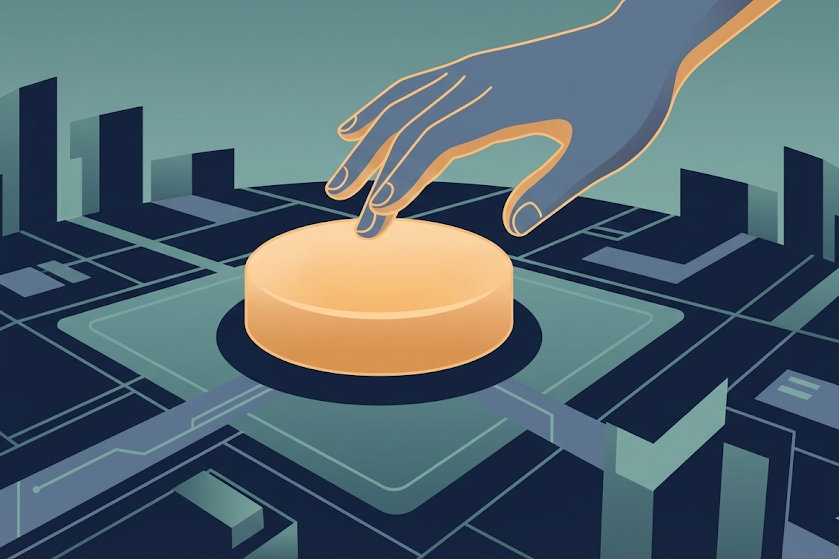
Imagine you are a senior DevOps engineer at a global company. It is 2:00 AM on a Tuesday, and you are staring at a deployment dashboard. A new update needs to go live. You see a single, bright green button labelled “Push to Global.” For years, your industry has told you that this button is the pinnacle of progress. It is fast, it is seamless, and it is frictionless. You click it. Within seconds, 8.5 million devices across the planet begin to crash. Flights are grounded, emergency services go dark, and the global economy stutters. This isn’t a hypothetical horror story; it is the reality of the 2024 CrowdStrike outage. The “frictionless” capability that was sold as a benefit, the ability to push threat definitions to all clients instantly, became the very mechanism of a global disaster.
For two decades, the tech industry has worshiped at the altar of efficiency. Driven by the commercial success of e-commerce and the “Don’t Make Me Think” philosophy popularized by usability experts, design has been a relentless race to reduce time-to-task to near zero. We have optimized our digital world to eliminate the gap between human impulse and digital execution. In the world of social media or online shopping, this seamlessness creates trillions of dollars in value. But as software moves from buying books to mediating healthcare diagnostics, financial markets, and aviation, this “frictionless” obsession has created an existential threat.
At CLOUDSUFI, we have spent years helping enterprises navigate the complexities of data and AI. But more importantly, we have seen this pattern emerge repeatedly in environments where mistakes are not recoverable. We work with some of the largest oil rigs in the world, predicting failures in massive turbines using voice and vibration signals long before breakdowns occur. We build digital twins for some of the most strategically important financial systems in the world. We solve problems in the mental health space, where automation intersects directly with human vulnerability. Across all of these domains, the same lesson keeps resurfacing: when systems become too easy to act on, humans stop thinking at exactly the moment they are needed most.
We are here to argue for a counter-intuitive truth: In high-stakes environments, the most valuable feature a system can offer is the ability to pause. We call this “Productive Friction”, the intentional engineering of cognitive speedbumps that force us to stop, think, and engage our human judgment.
The Myth of Frictionless Progress
The standard doctrine taught to every junior designer and encoded in every product manager’s KPIs is simple: minimize cognitive load, optimize the funnel, and reduce interaction cost. Friction is treated as an “anti-pattern,” a failure of design that must be hunted down and destroyed.
This philosophy makes a dangerous assumption: that the user’s intent is always clear, their actions are always deliberate, and the cost of an error is always low. When you accidentally select the wrong song on a playlist, the cost is trivial. But when that same “frictionless” logic is applied to a nuclear control panel, an electronic health record, or a billion-dollar trading algorithm, the results are often catastrophic.
By smoothing out every edge of interaction, we actually deprive human operators of the tactile and mental feedback they need to understand what the system is doing. We create a situation where the software hides small errors until they snowball into a critical failure, at which point it suddenly hands control back to a human who is startled, confused, and completely unprepared to take over. We have treated the human mind as a bottleneck to be widened, rather than a safety system to be engaged.
The Science of the “Cognitive Miser”
Why is slowing down so hard for us? To find the answer, we have to look at the architecture of the human brain. Cognitive science describes the brain as a “cognitive miser”, an organ that is evolutionarily wired to conserve energy by avoiding difficult thinking tasks whenever possible.
Nobel laureate Daniel Kahneman broke this down into “Dual-Process Theory”:
- System 1: This is our autopilot. It is fast, intuitive, emotional, and subconscious. It allows us to drive on an empty highway while listening to the radio. It is efficient, but it is highly prone to bias and error.
- System 2: This is our analytical engine. It is slow, logical, and conscious. It handles complex math and error checking. It is reliable, but it is exhausting for the brain to maintain.
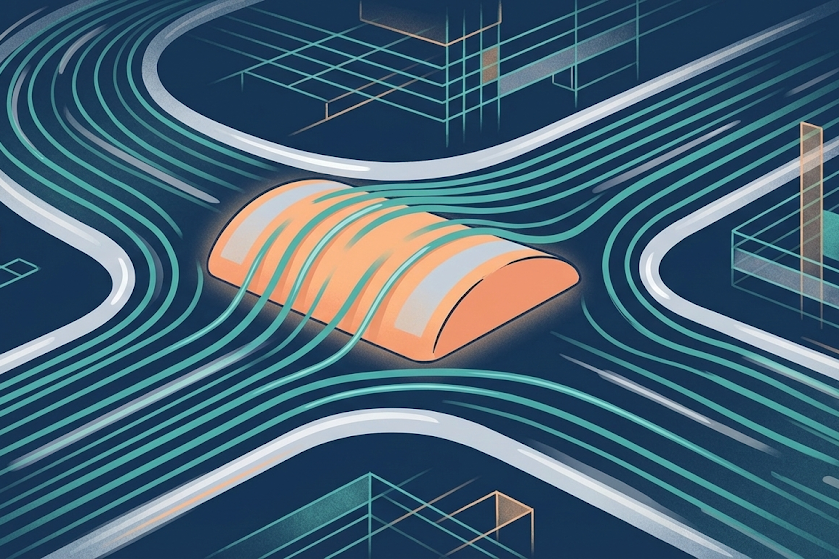
Frictionless design is explicitly built to keep you in System 1. It uses smooth transitions and “invisible” automation to encourage us to operate on instinct. In high-stakes environments,like when a doctor is reviewing a cancer scan,this suppression of System 2 is a recipe for disaster. We need the doctor to doubt. We need the trader to verify. Productive friction provides the “rumble strip” that shakes the operator out of complacency and forces them into an analytical state.
Research into this actually shows that making information slightly harder to read or process can improve the quality of a decision. When information flows too easily, our brains assume it’s true without checking. By introducing a “speedbump”,like a harder-to-read font or a required manual input,we break that autopilot and force the brain to evaluate the data.
When Speed Becomes a Liability: Real-World Disasters
The history of the last decade is littered with the wreckage of frictionless systems.
1. Aviation: The Silence of the Controls
In 2009, Air France Flight 447 disappeared into the Atlantic. The plane featured a “fly-by-wire” side-stick controller. Unlike traditional yokes, these sticks were electronic and uncoupled. When the pilot in the right seat pulled back on his stick, the stick in the left seat didn’t move. There was no physical feedback,no “productive friction”,to show the other pilot what was happening. Because the design was so “seamless,” the senior pilots didn’t realize a junior pilot was holding the nose up in a fatal stall until it was too late.
2. Finance: Losing $440 Million in 45 Minutes
Knight Capital Group was once a market giant. In 2012, they lost nearly half a billion dollars in under an hour because of a software glitch. Their system was built for millisecond execution speed, but it lacked a “financial circuit breaker”,a piece of productive friction that would have automatically stopped the system once losses hit a certain threshold. They had incredible speed, but negative “velocity”, they were moving incredibly fast in the wrong direction.
3. The 56.9% Error Rate
A study on medical software revealed the lethality of “Automation Bias”, our tendency to trust the computer even when it’s wrong. When the software gave clinicians correct advice, errors went down. But when the system was programmed to give incorrect advice, prescribing errors increased by a staggering 56.9%. The doctors, despite their years of training, allowed the “frictionless” suggestion of the AI to override their own judgment because the system made it too easy to just click “OK”.
Defining “Good” Friction
We often hear the objection: “Doesn’t friction just make for a bad user experience?” Our answer is that it depends on the stakes.
- Bad Friction is unintended difficulty: slow load times, broken links, or confusing menus that lead to frustration and abandonment.
- Productive Friction is a deliberate choice: mandatory confirmation steps, typing out a word to delete a file, or multi-factor authentication (MFA).
Take the “Type-to-Confirm” pattern used by AWS and GitHub. To delete a critical production database, you can’t just click a button. You have to type the exact name of that database into a text field. This is a “hard” friction pattern. It is impossible to do with your brain’s autopilot. It forces you to switch to System 2, ensuring that you are acting on the specific resource you intended to delete.
Another example is the “Checklist Effect”. In surgery, a mandatory “Time Out” checklist has been shown to reduce mortality rates by up to 36%. This friction breaks “tunnel vision” and empowers even the most junior staff to speak up if something feels wrong. It is a designed pause that saves lives.
The Strategic Shift: Velocity Over Speed
At CLOUDSUFI, we often encounter business leaders who are afraid of slowing down. They conflate “speed” with “velocity”.
In physics, speed is just how fast you are moving. Velocity is speed with direction. In business, a team that ships code instantly but breaks the entire system has high speed but zero (or negative) velocity because of the time they will spend on rollbacks and damage control.
Productive friction is essentially an insurance premium. You pay a small “tax” in seconds,a brief pause for verification,to insure yourself against a catastrophic “tax” in millions of dollars of capital or lost reputation. For a typical Fortune 500 company, rushed or ineffective decision-making costs an estimated $250 million annually in wasted wages and rework.
Our Perspective: Engineering for Judgment
As we enter the era of Agentic AI, where AI models don’t just suggest things, but actually take actions,the need for productive friction has never been greater. AI models are probabilistic, not deterministic; they hallucinate, they drift, and they carry biases. A frictionless interface that executes AI decisions instantly is a liability engine.
CLOUDSUFI’s philosophy is built on three core pillars of safety-critical design:
1. A Human Focused Architecture
We don’t believe in the “Magic Button.” We build “Approval Gates” for high-stakes AI actions. For example, if an AI generates code or approves a loan, the “Execute” button might not even be clickable until the human operator has scrolled through the plan or checked a box acknowledging specific risks. This prevents “rubber stamping” and ensures the human is actually doing the job they are there to do: judging.
2. Operational Circuit Breakers
Just as Knight Capital needed a financial break, modern AI agents need “token velocity” limits. We implement middleware that monitors how fast an AI is spending money or calling tools. If it exceeds a certain limit, the circuit “opens,” pausing the agent and forcing a human to review the anomaly.
3. Cognitive Transparency (Thinking Traces)
To combat the tendency to blindly trust the computer, we design interfaces that show the AI’s “work.” Instead of just showing a final answer, the UI displays the steps the AI took. This adds visual noise and cognitive load,deliberately, so that the user can spot logic errors before they become problems. It engages System 2 by exposing the scaffolding of the decision.
Conclusion: Designing for the “Break Glass” Moment
The era of “move fast and break things” is over for anyone responsible for critical systems. We have seen that speed without friction is simply uncontrolled acceleration.
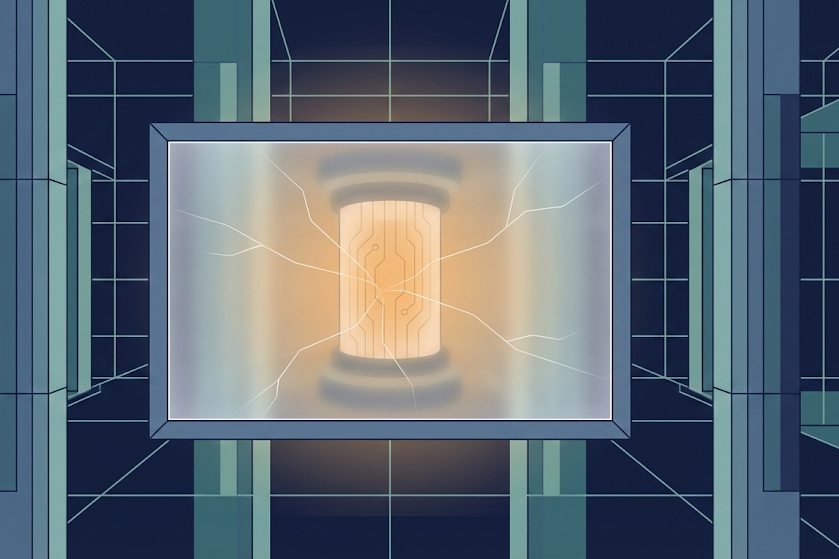
At CLOUDSUFI, we advocate for a “Friction Audit” of your most critical user journeys. We help identify the high-stakes actions that are currently too easy to perform and engineer the right barriers in the right places. We use the “Break Glass” metaphor: the glass provides friction to prevent accidental use, but once the decision to act is made, the glass breaks easily so you can do what needs to be done.
The next generation of enterprise AI will not be defined by who can make decisions the fastest. It will be defined by those who have the maturity to design for the pause. Because in a world of blindingly fast automation, the most valuable thing a system can offer you is a moment to think.