
Artificial intelligence has moved decisively beyond experimentation. For most large enterprises, AI is now embedded in core operations—shaping decisions that affect customers, employees, regulators, and markets. With that shift comes a fundamental change in how AI must be viewed. It is no longer just a technical capability; it is a matter of control, accountability, and governance.
This transformation in perspective is being driven by the growing recognition that AI, while a powerful enabler of efficiency and innovation, also carries with it significant responsibilities. The implications of AI are no longer confined to the IT department or innovation labs; instead, they cut across every business function and stakeholder group. Decisions made by AI systems can impact customer experiences, employee welfare, regulatory compliance, and even the organisation’s position in the market. As such, enterprises are being compelled to re-evaluate their approach to AI, moving beyond the initial excitement of adoption to a more mature focus on sustained, controlled, and responsible deployment.
Analysts such as Gartner have rightly noted that the future of AI will be defined not only by innovation velocity, but by how effectively organisations govern AI systems at scale. The growing focus on Sovereign AI reflects this reality. Enterprises are being forced to reassess how much control they truly have over their data, models, and AI-driven outcomes in an environment shaped by regulatory pressure, geopolitical risk, and rising public scrutiny.
As AI systems become more deeply woven into business processes, the stakes associated with their operation rise dramatically. Regulatory bodies are increasing their scrutiny, demanding proof of compliance with data privacy, security, and ethical standards. Geopolitical factors are influencing where and how AI solutions can be deployed, with countries and regions establishing their own rules for data sovereignty and technology usage. Moreover, the public’s expectations around transparency and fairness in automated decision-making are higher than ever, with trust quickly eroding in the face of perceived bias or lack of accountability.
In this landscape, AI governance is no longer optional—it is an imperative. Enterprises must establish robust frameworks that ensure visibility, traceability, and accountability at every stage of the AI lifecycle. This includes not only the technical aspects of model development and deployment, but also the upstream processes of data acquisition, curation, and management. By embedding governance into the fabric of their AI initiatives, organisations can safeguard against operational risks, ensure compliance with evolving regulations, and build the trust required to fully realise the benefits of AI-driven transformation.
Ultimately, the ability to maintain control over AI systems—what data they use, how they make decisions, and how outcomes are monitored and adjusted—will determine which enterprises thrive in the era of intelligent automation. Those that succeed will do so not only through technological prowess, but by demonstrating a disciplined, principled approach to AI governance that aligns with the expectations of customers, regulators, and society at large.
Defining Sovereign AI: Beyond Infrastructure
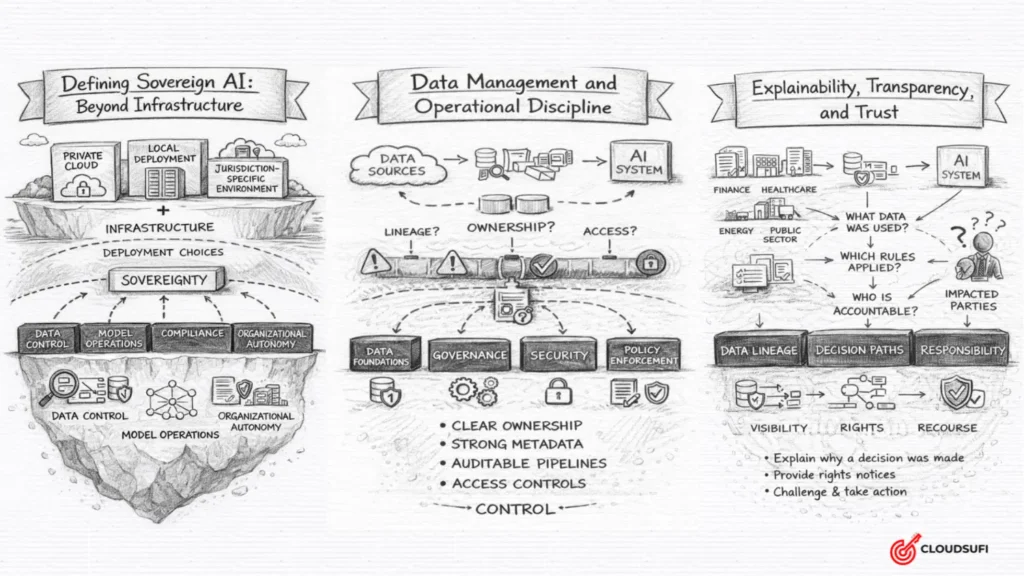
Sovereign AI is often introduced through infrastructure choices—local deployments, private clouds, or jurisdiction-specific environments. These decisions matter, but they address only a narrow slice of the problem. True AI sovereignty is not achieved by where systems run, but by how they are governed.
In practical terms, sovereignty means retaining control over the entire AI lifecycle: data, models, operations, and compliance. It extends beyond data residency to include operational resilience, security posture, regulatory alignment, and strategic autonomy. Without these, “sovereign” becomes a deployment label rather than an enterprise capability.
AI systems do not exist in isolation. They are built on complex data ecosystems where information flows across ingestion pipelines, analytics platforms, and operational systems long before it reaches a model. If governance is weak at these foundational layers, AI rapidly becomes opaque and difficult to control—regardless of how carefully the infrastructure has been chosen.
True sovereignty in AI begins with establishing robust data foundations. This entails unambiguous data ownership, comprehensive metadata management, stringent access controls guided by established policies, and processing pipelines that are fully auditable from end to end. Unless these fundamental elements are embedded within the data architecture, the notion of sovereignty remains aspirational rather than operational reality.
Data Management and Operational Discipline
Enterprises that struggle with AI governance rarely fail at the model layer. They fail upstream. Data is copied, transformed, enriched, and reused across teams and regions. When lineage, ownership, and access controls are unclear, AI systems inherit that ambiguity. The result is not just technical risk, but operational and regulatory exposure.
This upstream vulnerability is amplified by the sheer complexity of modern data ecosystems. As data traverses multiple pipelines—often crossing organisational and jurisdictional boundaries—each handoff introduces potential gaps in oversight. Without a clear record of who owns which dataset, how it has been altered, and who has accessed it, organisations lose the ability to enforce policy, maintain accountability, and ensure compliance. In such an environment, even the most sophisticated AI models become black boxes, obscuring the origins and integrity of the information they process.
Moreover, these weaknesses can cascade throughout the AI lifecycle. If the provenance of data is uncertain or poorly documented, it becomes nearly impossible to validate model outputs or ensure that decisions are made in accordance with regulatory and ethical requirements. This lack of transparency not only heightens the risk of inadvertent data misuse or bias but also undermines trust among stakeholders—be they customers, regulators, or business partners. Ultimately, robust governance at the data layer is foundational to achieving true AI sovereignty, providing the clarity and control needed to support secure, compliant, and auditable AI operations.
Recent research from firms such as McKinsey underscores a pivotal reality: the next stage of AI adoption will hinge not merely on strategic intent, but on how rigorously organisations operationalise their vision of sovereignty. This means moving beyond aspirational statements and taking concrete action to embed sovereignty principles throughout the AI lifecycle. Enterprises must invest in tightly controlled compute environments that ensure data and model processing occurs within defined jurisdictional and security boundaries. In parallel, data access rules must be strengthened, with granular entitlements and dynamic controls that are consistently enforced across business units and geographies. Crucially, governance must be woven directly into data and AI workflows—covering data ingestion, transformation, modelling, deployment, and monitoring—so that compliance, traceability, and accountability are inherent features rather than afterthoughts documented post-implementation. In this evolving landscape, sovereignty is not just a regulatory concept or a technical feature—it is a core operating discipline that determines an enterprise’s capacity to maintain control, demonstrate compliance, and adapt to emerging risks in a rapidly changing environment.
Governance, Compliance, and Regulatory Alignment
The regulatory environment around AI is tightening rapidly. Gartner projects that AI governance will become mandatory under sovereign AI regulations within the next few years. Organisations that fail to integrate governance models early will face both compliance risk and competitive disadvantage.
This shift is already visible. Enterprises are enhancing data governance frameworks to manage cross-border data flows, establishing formal AI governance bodies, and investing in trust, risk, and security management capabilities. Performance and accuracy remain important, but they are no longer sufficient measures of success.
What is emerging is a new standard for AI adoption—one where compliance, resilience, and demonstrable oversight are prerequisites for operational legitimacy. Regulatory scrutiny is increasing, with authorities across jurisdictions moving towards more prescriptive requirements on data localisation, model transparency, and auditability. As a result, enterprises are compelled to proactively embed governance not just in policy documents, but directly within their AI and data workflows. This includes implementing robust mechanisms for monitoring data lineage, enforcing access controls, and providing clear records of all decisions made by AI systems.
Furthermore, boards and executive leadership are recognising that governance is not merely a matter of regulatory compliance, but a strategic imperative that underpins stakeholder trust and long-term competitiveness. The ability to demonstrate that AI systems operate within established policies, respect jurisdictional boundaries, and are resilient to both technical and ethical risks is becoming a key differentiator. In this context, enterprises are prioritising investments in explainability, traceability, and continuous assurance practices—ensuring that every stage of the AI lifecycle is subject to rigorous oversight and can withstand both internal and external scrutiny.
Ultimately, as the regulatory landscape continues to evolve, those organisations that treat governance as a core operating discipline—rather than a compliance checkbox—will be best positioned to adapt, innovate, and lead in the era of sovereign AI.
Reliability, traceability, and accountability now carry equal weight in the governance of AI systems. These elements are no longer optional or secondary considerations; they are fundamental to establishing operational legitimacy and maintaining stakeholder trust. In today’s regulatory climate, enterprises must move beyond verbal assurances to provide tangible, verifiable evidence that their AI systems are functioning as intended. This means they must be able to clearly demonstrate that AI models operate strictly within defined organisational rules and policies, adhere to relevant jurisdictional and regulatory constraints, and are robust enough to withstand detailed audit and regulatory scrutiny.
To achieve this, organisations need to implement comprehensive monitoring and documentation mechanisms throughout the entire AI lifecycle. This includes maintaining detailed records of data provenance, transformation steps, model training processes, access logs, and all decisions made by AI systems. Such rigorous oversight enables enterprises not only to comply with current regulations, but also to quickly adapt to evolving legal and ethical standards across different regions. Furthermore, by embedding traceability and accountability into every stage—from data ingestion to model deployment and ongoing monitoring—enterprises can more readily identify and address issues such as bias, data misuse, or operational failures. This proactive approach is essential for building trust with customers, regulators, and business partners, and for safeguarding the organisation’s reputation and competitive edge in an increasingly scrutinised landscape.
Ultimately, the capacity to provide evidence of compliance, explainability, and ethical operation is becoming a critical differentiator. Those organisations that treat these principles as core operating disciplines—rather than mere compliance checkboxes—will be best positioned to thrive as sovereign AI becomes the new standard.
Explainability, Transparency, and Trust
Explainability has become one of the most misunderstood aspects of AI governance. For most enterprises, this is not about interpreting model internals. It is about answering practical questions: Why did the system behave the way it did? What data was used? Which policies applied at the time? Who is accountable for the outcome?
Addressing these questions necessitates robust, end-to-end visibility across the entire AI value chain—from the initial data sources, through all transformation and processing steps, right up to the final decision outputs. This level of transparency is especially crucial in regulated sectors such as financial services, healthcare, energy, and the public sector, where individuals and institutions are not only entitled to clear explanations but may also require avenues for recourse in the event of adverse outcomes. Without such visibility, organisations risk not only non-compliance but also erosion of public and stakeholder trust.
To meet these transparency demands, enterprises must implement mechanisms that log and trace data lineage, capture model decision rationale, and document all policy applications throughout the AI lifecycle. For example, in banking, being able to explain why a loan was denied, which data contributed to that decision, and who reviewed or approved the model is now a regulatory expectation. Similarly, in healthcare, patients and providers require clarity around the recommendations produced by AI systems, ensuring that these technologies act as tools for empowerment rather than sources of opacity or bias.
Global bodies such as the OECD have already embedded transparency and explainability into their AI principles. These are no longer aspirational ideals; they are becoming enforceable expectations. Regulatory authorities in multiple jurisdictions are moving towards mandatory requirements for AI explainability, requiring organisations to provide clear and auditable records of how decisions are made, which safeguards are in place, and who is ultimately responsible. This shift is transforming explainability from a technical challenge into a business imperative and a cornerstone of ethical AI deployment.
Ultimately, transparency and explainability underpin trust. Enterprises that can consistently demonstrate the reasoning behind their AI systems’ actions are better equipped to build confidence with regulators, customers, and partners. By embedding explainability into every stage—from data ingestion, policy application, through to final output—organisations lay the groundwork for responsible AI adoption. This not only supports regulatory compliance but also strengthens reputational capital, making trust and transparency enduring sources of competitive advantage in the era of sovereign AI.
Operationalising Sovereign AI
Sovereign AI cannot be bolted on after deployment. It must be built into enterprise platforms and operating models from the outset. This foundational approach ensures that AI systems are not merely add-ons, but intrinsic components of the organisation’s infrastructure, working in harmony with existing business processes and regulatory requirements.
This means integrating AI workloads into enterprise-grade environments that support monitoring, governance, and policy enforcement across regions and regulatory boundaries. Enterprises must ensure that these AI initiatives are tightly aligned with existing security frameworks, data governance programmes, and compliance obligations, rather than being treated as siloed innovation projects. By embedding AI into the core operational fabric, organisations can more effectively manage risks and adapt to evolving legal requirements.
Common best practices emerging across industries include:
- Boundary control over where data and prompts can flow: Organisations must rigorously define and enforce boundaries regarding the movement of data and AI-generated prompts, both within and across jurisdictions. This involves implementing robust access controls, network segmentation, and data localisation policies to ensure compliance with regional regulations and to safeguard sensitive information.
- Key management and encryption ownership: The secure management of cryptographic keys and ownership of encryption processes are critical for protecting data integrity and confidentiality. Enterprises need to establish protocols for key rotation, secure storage, and access management, ensuring that only authorised personnel can handle encryption keys and that data remains protected at rest and in transit.
- Full observability of AI operations: Achieving comprehensive visibility into the functioning of AI systems is essential. This entails deploying monitoring tools that track system performance, data flows, and decision-making processes in real time. Detailed logging and audit trails should be maintained to support regulatory audits and internal reviews, enabling organisations to quickly identify and address any anomalies or breaches.
- Clear incident response mechanisms: Organisations must establish and regularly test incident response protocols specific to AI operations. This includes procedures for detecting, reporting, and mitigating potential issues such as data leaks, model failures, or unauthorised access. A well-defined escalation path and periodic tabletop exercises help ensure readiness in the face of operational disruptions.
- Operational resilience when dependencies fail: Resilience planning is vital for maintaining continuity in the event of third-party service outages, supply chain disruptions, or technology failures. This involves building redundancy into critical systems, conducting regular risk assessments, and maintaining contingency plans that enable rapid recovery and minimal business impact.
These are not theoretical concerns; they are operational necessities. By prioritising these best practices, organisations safeguard their AI investments, uphold regulatory compliance, and build a foundation of trust with stakeholders. Operationalising sovereign AI is an ongoing discipline—one that requires continuous vigilance, adaptability, and a proactive approach to risk management and ethical governance.
Building Resilience and Strategic Value
Sovereign AI is not about slowing innovation. Rather, it is about enabling organisations to innovate at scale while maintaining robust control over risks that could otherwise become unmanageable. By embedding resilience into the very fabric of AI programmes, enterprises ensure that technological advancements do not come at the expense of security, privacy, or regulatory compliance. This proactive approach to innovation allows organisations to harness the full potential of AI, confident that their operations remain safeguarded against emerging threats and shifting legal landscapes.
Organisations that invest early in strong data foundations, governance-first architectures, and operational discipline will be better positioned to navigate regulatory change and geopolitical uncertainty. Establishing clear policies for data stewardship, access management, and ethical decision-making fosters a culture of accountability and transparency. Such disciplined operational frameworks not only help enterprises adapt to new regulations and cross-border data requirements, but also provide the agility needed to respond to global market disruptions and evolving stakeholder expectations.
When executed effectively, sovereign AI transforms compliance from a perceived cost centre into a strategic advantage. Rather than viewing regulatory obligations as hurdles, organisations can leverage robust compliance protocols to differentiate themselves in the marketplace—building trust with customers, regulators, and partners. This enhanced credibility translates into stronger relationships and improved brand reputation. Furthermore, by integrating resilience planning—such as redundancy, incident response, and continuous monitoring—organisations increase their ability to withstand operational shocks, maintain business continuity, and drive sustainable growth. Ultimately, sovereign AI positions enterprises not just to survive, but to thrive, becoming leaders in resilience and long-term competitiveness in an increasingly complex global environment.
The Global Context
The push toward sovereign AI is being driven by more than regulation. Strategic security concerns, cultural and linguistic representation, and economic self-determination all play a role. Governments and organisations globally are increasingly recognising the need to safeguard their technological autonomy and to shield critical infrastructure from external influence or vulnerabilities. This imperative has prompted countries to enact legislation and policies that reflect national interests, such as the EU AI Act and India’s DPDP Act, which are compelling organisations to reassess dependencies on foreign technology vendors and to rethink how value, control, and accountability are distributed across the AI landscape.
Furthermore, sovereign AI lays the groundwork for systems that better represent local languages, norms, and cultural values. This localisation ensures that AI solutions are not only technically robust but also socially relevant, fostering inclusivity and meaningful engagement with diverse communities. Importantly, it empowers citizens and institutions by providing transparent mechanisms for recourse and redress when algorithms fail or produce unintended outcomes, thus reinforcing trust in intelligent systems.
As Gartner’s analysis suggests, the next phase of AI adoption will be defined less by who builds the most powerful models and more by who can deploy AI systems that are controlled, explainable, and accountable in the real world. This evolution marks a significant shift in focus—from sheer computational prowess to operational discipline and ethical stewardship. Organisations will need to demonstrate not only technical excellence but also the capacity to manage AI responsibly, ensuring transparency in decision-making and accountability for outcomes.
Sovereign AI is not a destination. It is an enterprise operating model for the age of intelligent systems, characterised by continuous adaptation and proactive risk management. Those who adopt it early will lead in an environment defined by regulatory complexity, strategic autonomy, and heightened expectations for responsible innovation. By embracing sovereign AI principles, organisations position themselves at the forefront of technological advancement, equipped to navigate global challenges and to drive sustainable value creation for all stakeholders.