TL;DR: Rolling out agentic AI across an enterprise is a five-phase sequence, not a single project: (1) pick one pilot workflow with a bounded outcome, (2) stand up the architecture — orchestration, tool access, memory — before scaling scope, (3) put governance and observability in place before the second use case, not the tenth, (4) run a controlled expansion one use case at a time, and (5) operationalize with cost controls, on-call ownership, and a reusable platform. Most failed rollouts skip straight to phase 4 with none of phases 2 and 3 done. This is the order that holds up in production.
Why "Learn Agentic AI" Is the Wrong Question for an Enterprise
Search interest in "roadmap to learn agentic ai" and "agentic ai learning path" comes from individual developers building a mental model one agent at a time. That's a real question. It isn't this one.
An enterprise doesn't need one person to learn agentic AI. It needs a repeatable way to take an agentic workflow from idea to production, twenty or a hundred times, without twenty or a hundred different architectures, security reviews, and quiet failure modes. The individual-learner framing optimizes for one engineer's understanding; the enterprise framing optimizes for what happens after that engineer's prototype works and three other teams want the same thing. This playbook treats agentic AI rollout as an organizational capability to build, phase by phase, not a skill to acquire.
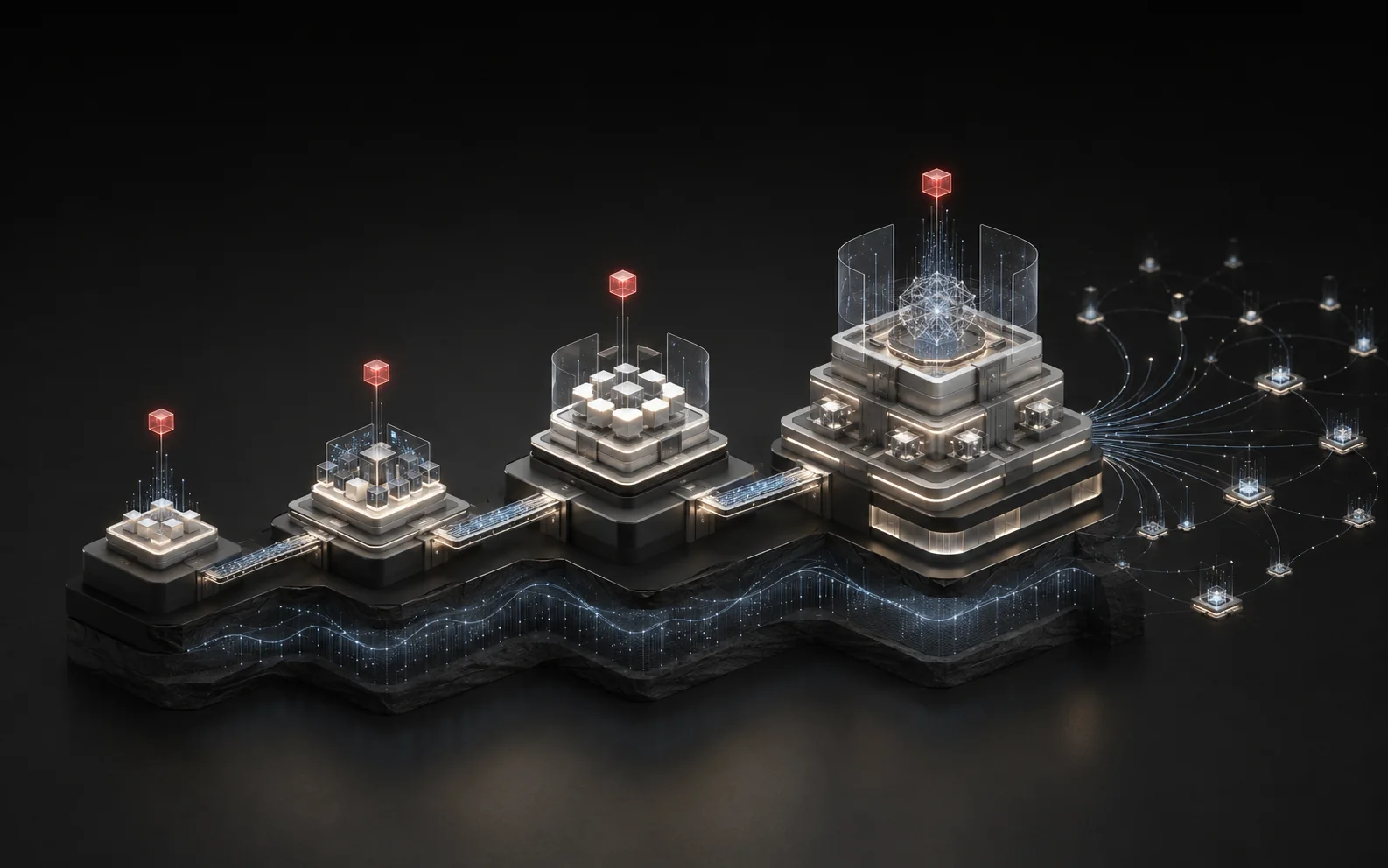
The Five-Phase Roadmap at a Glance
Phases 2 and 3 run in parallel — architecture without governance produces an agent nobody can safely turn on, and governance without architecture has nothing to govern.
Phase 1: Select a Pilot Workflow With a Bounded, Measurable Outcome
The single biggest predictor of a stalled program is picking a pilot too broad to finish or too narrow to matter.
Selection criteria that hold up in practice:
- Bounded scope. Clear start and end state — a ticket triaged, a report generated, a record reconciled. Open-ended "assistant" pilots rarely reach a go/no-go decision because there's no fixed target to measure against.
- Existing process to replace or augment. A workflow already done manually today, with a known cycle time and error rate, gives a real baseline instead of an estimate.
- Tolerant of imperfection early. Not the workflow where a wrong answer is expensive — customer refunds, compliance filings, anything customer-facing at first contact. Save those for phase 4, once governance and observability are in place.
- Data and tool access already exist. A pilot needing three new integrations before an agent does anything useful is an integration project wearing an agentic AI label.
A pattern that works: internal, back-office, augment-don't-replace, human reviewing every output for the first several weeks. Categorizing support tickets, drafting first-pass responses, summarizing long documents, reconciling two systems of record and flagging discrepancies — common starting points because failure is cheap and recoverable.
Define before writing any code: the exact input and output of the workflow, the current manual baseline (time, cost, error rate), the success threshold for moving to phase 2 (a number, not a feeling), and who owns the pilot decision — a named owner with authority to green-light or kill it, not "the team liked it."
For the patterns that make a single agent reliable before multi-agent complexity gets added, the guide on intelligent agent architecture is worth reading before phase 2 starts, since the pilot's tech choices shape everything after.
Phase 2: Set Up the Architecture Before Scope Grows
Once the pilot workflow is chosen, the architecture question isn't "which model" — it's what the agent runs on, how it gets tools, and how it remembers state. Getting this wrong means rebuilding it in phase 4, at much higher cost, with production traffic already depending on it.
Decisions to make deliberately, not by default:
- Orchestration pattern. Single agent with tool access, or a supervisor coordinating specialist sub-agents? Single-agent-with-tools is almost always the right phase 2 choice — multi-agent orchestration adds coordination failures hard to debug without observability already in place.
- Tool and data access boundaries. What can the agent call, read, and write — the minimum needed for the pilot, or "everything, in case it's useful later"? Scope creep here is the most common cause of phase-4 security review delays.
- Memory and state. Does the agent need to remember across turns, across sessions, or not at all? Stateless should be default unless the workflow genuinely requires persistence.
- Model selection and fallback. Which model handles the core reasoning, and what happens when it's unavailable or returns something malformed? No fallback path means the pilot isn't ready for phase 4 traffic.
This isn't a deep dive into orchestration patterns, memory architectures, or tool-calling design — that ground is covered fully in the intelligent agent architecture primer, worth reading before finalizing phase 2 decisions rather than re-deriving the same tradeoffs from scratch.
One decision deserves a dedicated look before phase 2 closes: connecting the agent to external tools and data sources in a standardized way, rather than a bespoke integration per tool. The MCP implementation roadmap covers that in detail and is the natural next read once tool access boundaries are being defined.
Phase 3: Put Governance and Observability in Place — Before the Second Use Case
This is the phase most rollouts skip, and it's the one that turns "the pilot worked" into "the program works." Governance and observability run in parallel with phase 2, not bolted on after the first agent ships.
A single pilot agent with a human reviewing every output can survive weak observability — the person catches the bad output first. That safety net disappears the moment a second use case ships, or the first moves to lower review. Retrofitting logging, tracing, and audit trails onto a live system afterward costs far more than building them in from the start.
Governance questions to answer before phase 4:
- Approval and escalation paths. Which agent actions execute automatically, which require human sign-off, and who is the human? Define per action type, not per agent.
- Audit trail. Can every agent decision be traced back to the inputs, tool calls, and reasoning that produced it? Matters for debugging and compliance.
- Access and permission review cadence. Who reviews what an agent can touch, and how often? Permissions accumulate; someone needs to own pruning them back.
- Failure and rollback plan. What happens when an agent produces something wrong in production — is there a kill switch, and does everyone know where it is?
Observability is the operational half of governance — measuring what agents are actually doing versus what they're supposed to do. This differs from traditional application monitoring: agent behavior is probabilistic, tool-calling introduces new failure modes, and a "successful" API response can still be the wrong decision. The comparison between AIOps and agent observability covers that difference in full — the reference for standing up phase 3 tooling, rather than adapting an existing APM stack and hoping it holds up.
Is your data ready for agentic AI?
Take the 3-minute assessment and see where your data foundation needs attention before you scale autonomous systems.
Get my readiness scorePhase 4: Scale in Controlled Increments, One Use Case at a Time
With one pilot proven and governance running, scale is a sequencing problem, not a technology problem. Controlled scale looks like:
- Add use cases one at a time, not in a batch. Each new workflow goes through the same selection discipline as phase 1 — bounded scope, known baseline, named owner — even though the platform now exists.
- Reuse the platform, not the agent. The orchestration, tool-access, and observability layer from phases 2–3 should serve every new use case. If each team rebuilds its own agent infrastructure, phase 2 wasn't a platform decision — it was a one-off.
- Graduate human-in-the-loop deliberately. Moving from "reviews every output" to "reviews a sample" to "acts autonomously within defined bounds" is an explicit decision per workflow — tied to an accuracy threshold from phase 3 data, not a timeline.
- Watch for cross-agent interference. Once agents share data sources or downstream systems, conflicts appear that didn't exist with a single agent — two agents updating the same record, competing for the same rate-limited API. Phase 2's architecture either holds up here or doesn't.
A sign scale is going wrong: each new use case takes as long to ship as the first one did. If phases 2 and 3 paid off, use case five ships faster than use case two, not at the same pace.
Phase 5: Operate — Cost, Ownership, and Drift
Agentic AI systems don't stabilize like traditional software. Model behavior shifts with provider-side updates, costs scale with usage harder to forecast than fixed infrastructure, and an agent performing well at launch can degrade as its data changes. Ongoing operation requires:
- A named owner per agent in production, the same way a service has an on-call owner — not "the team that built it," but a specific accountable role once the builders move on.
- Cost monitoring per agent and per workflow, not just aggregate spend. Token and tool-call costs grow non-linearly with input complexity; without per-workflow visibility, cost problems surface as a surprise invoice, not a trend.
- Scheduled re-evaluation against the phase 1 baseline, checked quarterly — model updates and data drift erode performance quietly.
- A change management process for prompt, tool, and model updates, treated like code changes with review and rollback, not config tweaks pushed straight to production.
This is where the phase 3 observability investment keeps paying off — the same tracing and metrics that caught early failures make ongoing drift visible instead of invisible.
Get the Full Rollout Checklist
Every question above — pilot selection, architecture decisions, governance sign-offs, scale gates, operating metrics — is laid out as a single checklist, phase by phase. The building agentic AI systems checklist (PDF) is the working version of this playbook: print it, walk each phase with the team building the first pilot, and reuse it for every use case after.
Common Sequencing Mistakes
- Skipping straight to multi-agent orchestration. Fix: ship single-agent-with-tools first; add orchestration once phase 3 observability exists.
- Building governance after the second use case. Fix: run phase 3 in parallel with phase 2, before any pilot reaches broader review.
- Picking a customer-facing, high-stakes pilot first. Fix: start internal, back-office, human-reviewed; save high-stakes workflows for phase 4.
- Rebuilding infrastructure per use case. Fix: treat phases 2–3 as a shared platform, not a one-off build.
- Measuring success by "the demo worked." Fix: define the phase 1 success threshold as a number before writing any code.
Frequently Asked Questions
What's the difference between a roadmap to learn agentic AI and a roadmap to build agentic AI systems in an enterprise?
Learning agentic AI is an individual skill-building path — understanding how a single agent reasons, calls tools, and handles state. Building agentic AI systems at the enterprise level is an organizational rollout problem: pilot, shared architecture and governance, then scaling across teams without every use case reinventing the platform.
How long does a full enterprise agentic AI rollout take, from pilot to scaled operation?
Phase 1 typically runs 2–4 weeks, phases 2 and 3 run in parallel over 4–8 weeks, and phase 4 is ongoing. A realistic timeline from pilot kickoff to a second production use case is 3–5 months, longer if governance and observability get built sequentially instead of in parallel with architecture.
Is there a downloadable PDF version of this agentic AI rollout roadmap?
Yes — the building agentic AI systems checklist (PDF) referenced above covers all five phases as a working checklist rather than narrative text.
Does an enterprise need a multi-agent architecture to get value from agentic AI?
No. A single agent with well-scoped tool access, running against a bounded workflow, is the right starting architecture for almost every pilot. Multi-agent orchestration adds value at scale but also coordination and debugging complexity, easier to manage once observability is already in place.
What should be governed first: the agent's outputs or its tool access?
Tool access. An agent's tool and data permissions define the blast radius of any mistake — governing what it can touch matters before governing how its outputs read. Output review catches a bad answer; permission boundaries prevent a bad action.
Which team should own an agentic AI pilot — product, engineering, or a dedicated AI team?
Product and engineering jointly, with a single named decision owner. A pilot with no clear owner tends to survive past its usefulness because no one has authority to call it done or kill it. A dedicated AI or platform team becomes more relevant starting in phase 2, once architecture decisions get made once and reused across future use cases.