
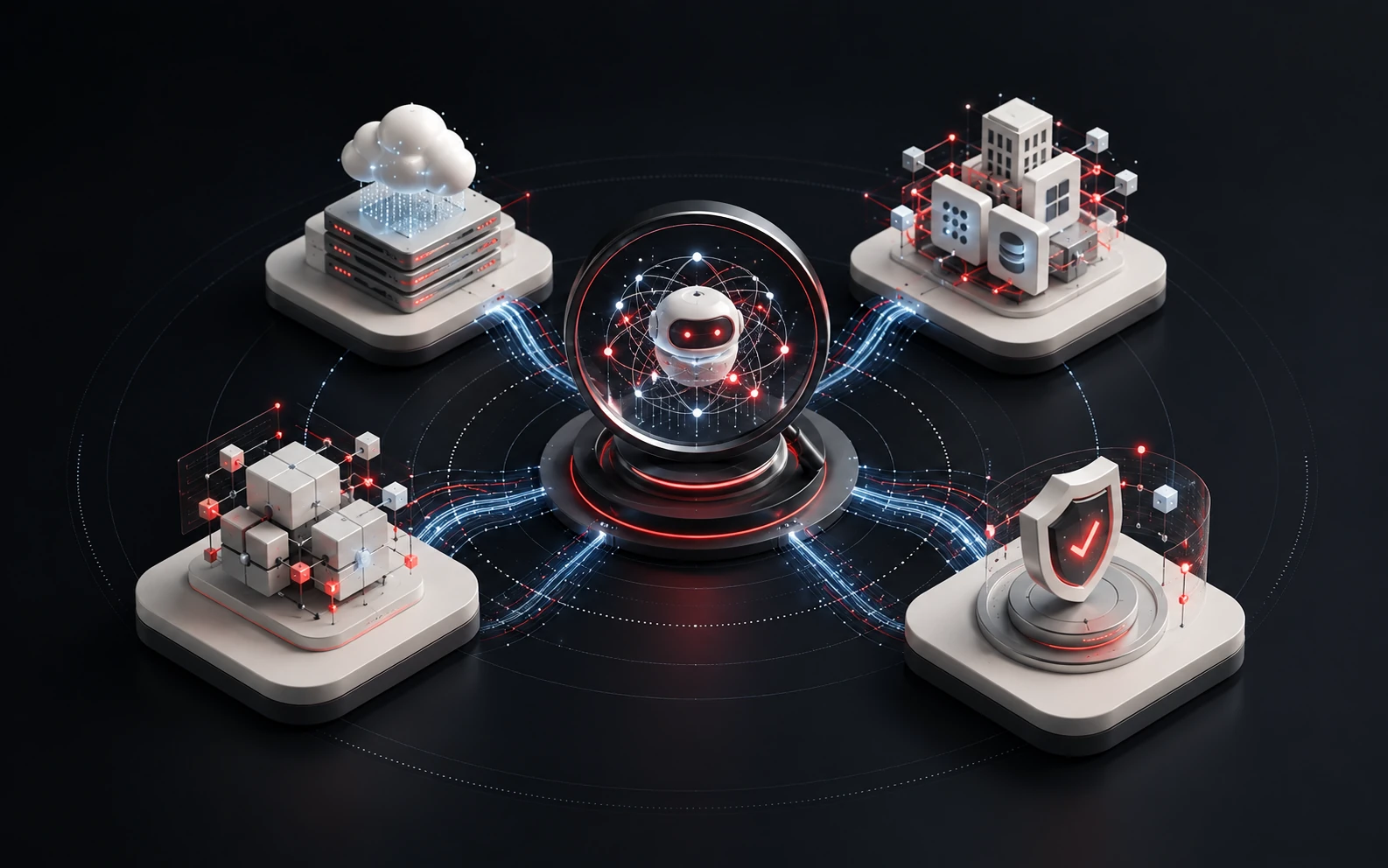
Why the platform label is misleading
An agent that answers questions from company knowledge has a different operating burden from one that updates a customer record or approves a transaction. Both may be marketed as AI agents, but the second needs stronger permissions, audit trails, exception handling, and a clear owner when something goes wrong.
That is why a feature checklist alone is a poor buying tool. First define the workflow and the systems it touches. Then determine whether the team needs a managed builder, an automation layer, a developer framework with operating tools, or production infrastructure.
The platform landscape at a glance
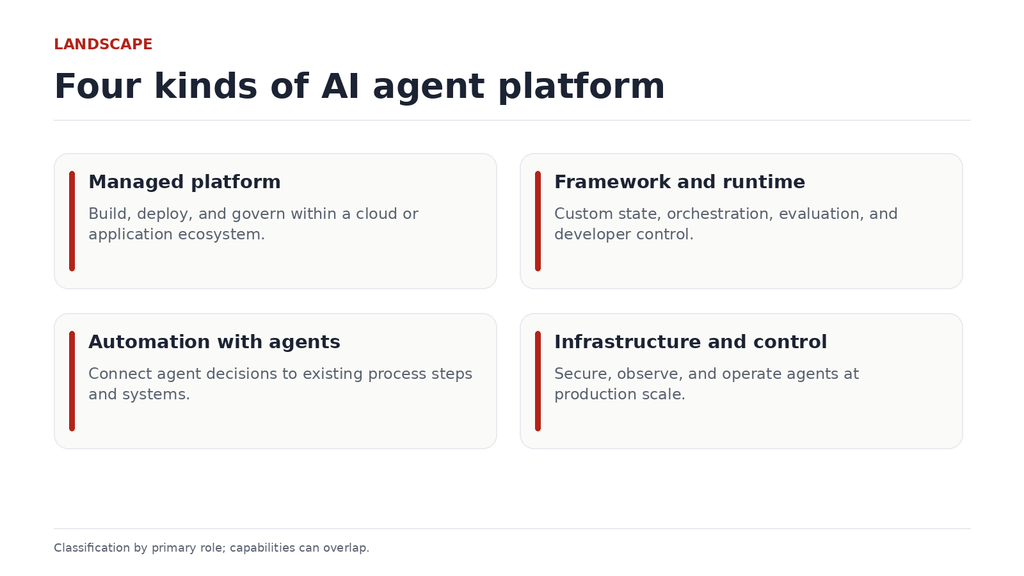
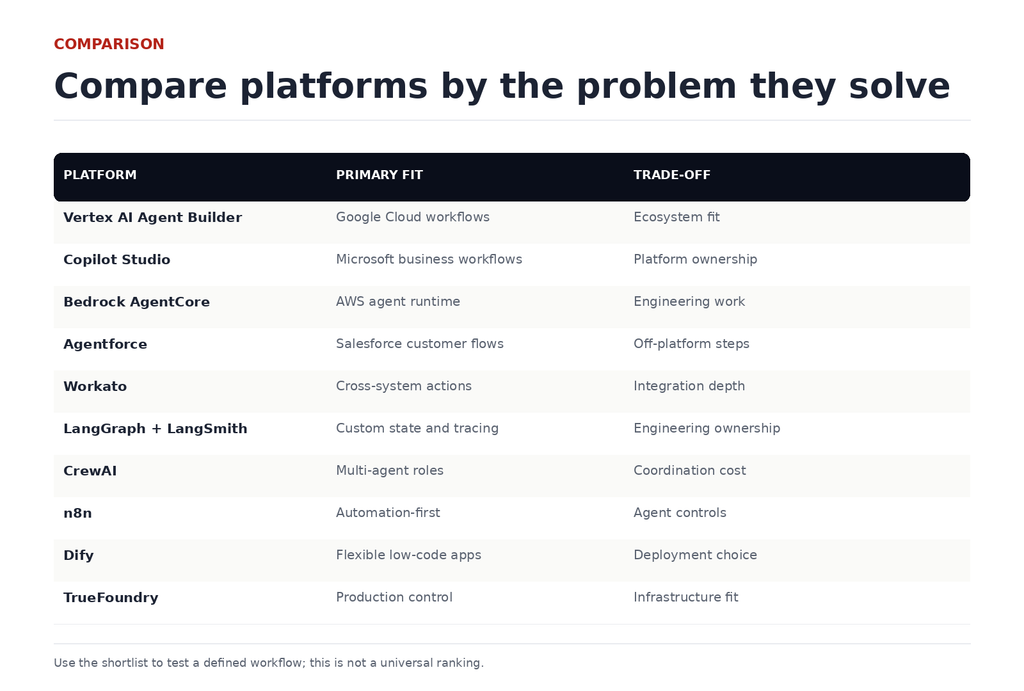
Google Vertex AI Agent Builder: managed development and operations for teams invested in Google Cloud. Microsoft Copilot Studio: low-code agents close to Microsoft applications and identity. Amazon Bedrock AgentCore: AWS-native runtime and operational infrastructure for developer-led systems. Salesforce Agentforce: customer workflows grounded in Salesforce data and processes. Workato: agents acting across connected business applications.
LangGraph with LangSmith: custom, stateful orchestration with tracing and evaluation. CrewAI: explicit multi-agent workflows. n8n: automation-first workflows with agent capabilities. Dify: flexible low-code AI application development and deployment. TrueFoundry: infrastructure and governance for agents in production. These are different categories; use the descriptions to form a shortlist, not to infer an overall winner.
Where each option fits
Google Vertex AI Agent Builder
Google Vertex AI Agent Builder is a strong starting point when agent development needs to remain close to Google Cloud data, APIs, security, and managed services. Its Agent Development Kit and Agent Engine support engineering and deployment. Test the degree of cloud dependence against any systems outside that environment.
Microsoft Copilot Studio
Microsoft Copilot Studio brings agent creation closer to business teams using Microsoft 365, Power Platform, and Dynamics. Its governance and identity integration matter most when those tools already underpin the workflow. Establish who approves changes and owns production testing even if the initial build is low-code.
Amazon Bedrock AgentCore
Amazon Bedrock AgentCore is closer to a production runtime than a visual business-user builder. AWS teams can use its runtime and operational controls while retaining choices about agent design. Compare the engineering work required to operate it with the convenience of a managed builder.
Salesforce Agentforce
Salesforce Agentforce fits service, sales, and other customer workflows whose data and business rules already reside in Salesforce. Its strongest argument is proximity to that context. Map the steps outside Salesforce before assuming the whole process will fit inside one platform.
Workato
Workato is relevant when an agent must take action across several enterprise applications. Integration and orchestration are central to the product. Assess its value against the number and complexity of actual cross-system actions rather than a conversational demo.
LangGraph + LangSmith
LangGraph and LangSmith suit engineers who need durable state, branching, approval points, traces, and evaluation around custom agents. That control comes with more design and operating responsibility. It is a good fit when the workflow cannot be reduced to a packaged agent pattern.
CrewAI
CrewAI organizes specialized agents into crews and flows, with deployment and monitoring tools around them. It is useful when distinct roles genuinely improve the workflow. Test whether one agent with tools could meet the same outcome with fewer handoffs.
n8n
n8n is an automation-first choice for teams that want to add AI agents to existing low-code workflows, including self-hosted options. It is best assessed as workflow automation with agent capabilities, especially when integrations and predictable process steps dominate.
Dify
Dify combines low-code AI application development with extensibility and a range of deployment options. Evaluate the fit of its workflow, knowledge, and operating features against the data-residency and customization requirements of the specific use case.
TrueFoundry
TrueFoundry focuses on agent infrastructure and governance rather than the initial business-user build. It belongs on the shortlist when the hard problem is operating, monitoring, and controlling agents as their use expands.
A practical selection test
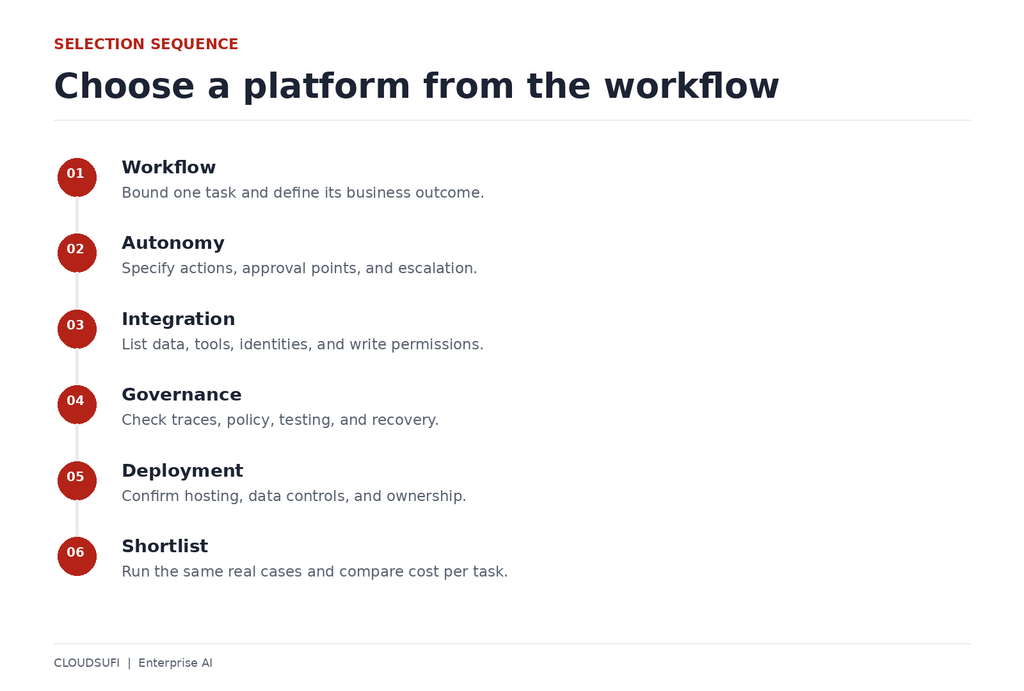
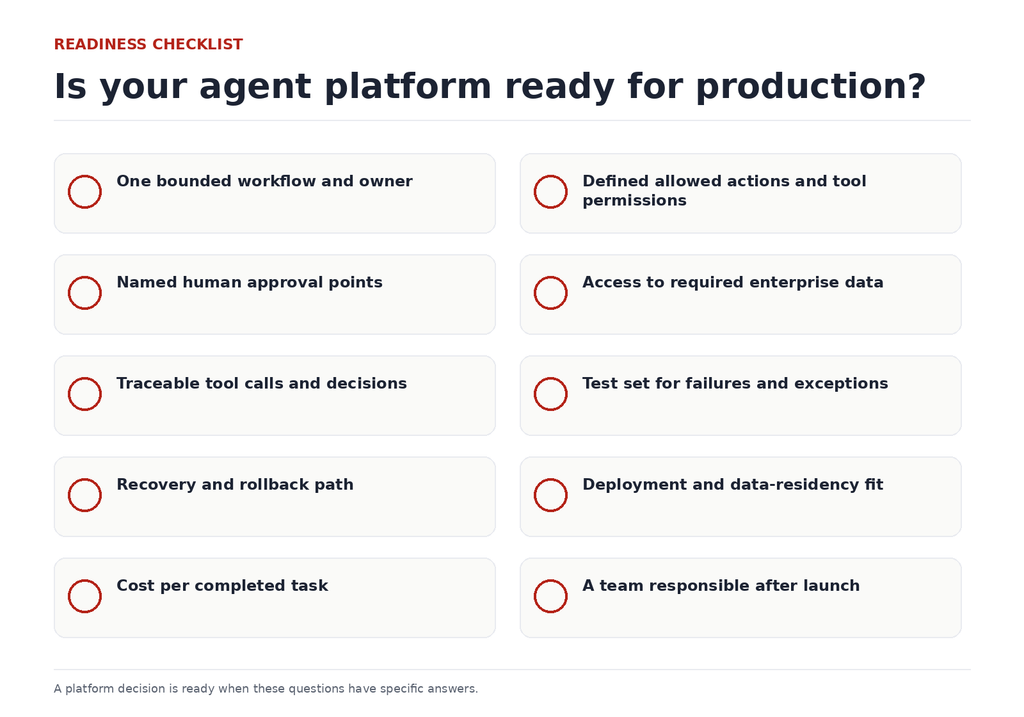
Pick a single bounded workflow, such as triaging one class of support ticket. Record which systems the agent reads and writes, the action it is allowed to take, and the cases that must go to a human. This immediately narrows the type of platform required.
Run the same representative cases on a short list. Check task completion, wrong actions, escalation rate, trace quality, recovery after a failed tool call, integration effort, and fully loaded cost per completed task. Ask who will maintain prompts, connectors, permissions, and evaluations after launch.
Finally, compare deployment and data controls against the enterprise architecture. A platform that performs well in a sandbox can still fail the selection if it cannot use the right identity, retain the required audit trail, or connect safely to the systems that matter.
When a platform is more than you need
A fixed workflow with known rules may be better served by conventional automation. A retrieval application may only need search and a model response. Buy an agent platform when dynamic decisions, tool use, and ongoing control justify the additional operational layer.
FAQ
What is an AI agent platform?
It is a set of tools for building and operating agents that use models, data, and tools to carry out tasks. The surrounding deployment, permissions, evaluation, and monitoring capabilities vary widely.
What is the difference between a platform and a framework?
A framework mainly gives developers control over agent logic and orchestration. A managed platform typically supplies more of the deployment and governance environment; some offerings blend both.
Which platform is best for an enterprise?
The one that can complete a defined workflow within the organization’s systems and control requirements at an acceptable operating cost. The answer changes with the workflow and the team that owns it.
Can agents integrate with existing systems?
Many can, but connector availability is only the beginning. Test the precise read and write actions, identity, permissions, error handling, and audit trail before treating an integration as production-ready.
The decision to take forward
Choose two or three options that fit the architecture, then prove them against a real workflow. CLOUDSUFI can help connect the data, orchestration, integration, and governance work needed to move that workflow into production.