
Start with the work the agent must do
A one-step assistant, a research agent, and a long-running process with human approval do not need the same architecture. Yet all three can appear in a framework demo. The useful question is which parts of the workflow must be explicit and recoverable when a tool fails or a person needs to intervene.
Frameworks give engineers reusable ways to coordinate models, tools, memory, data, and execution. They generally leave more implementation responsibility with the team than a managed agent platform. That trade-off is worthwhile when a generic builder cannot express the control the workflow needs.
Eight frameworks at a glance
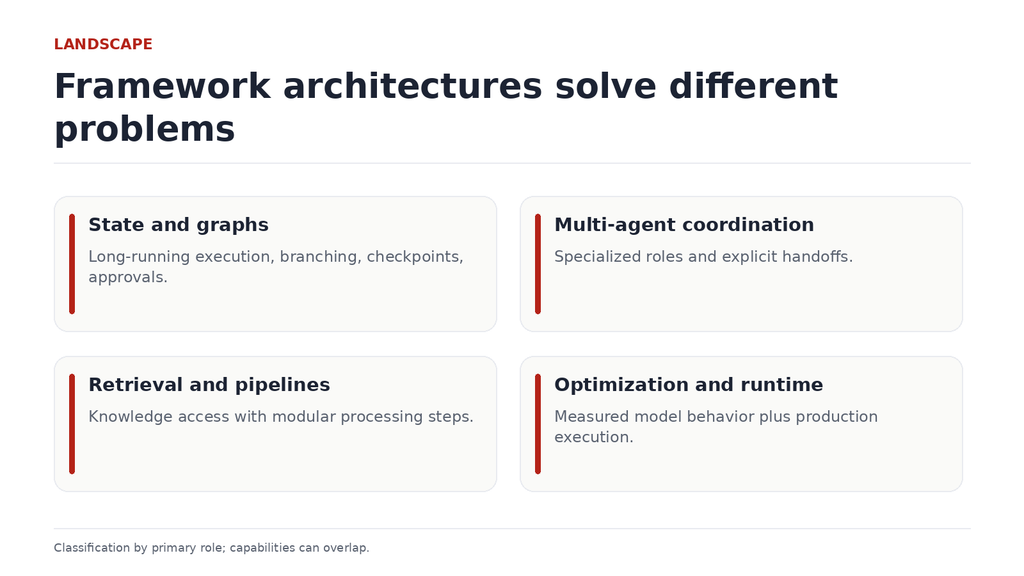
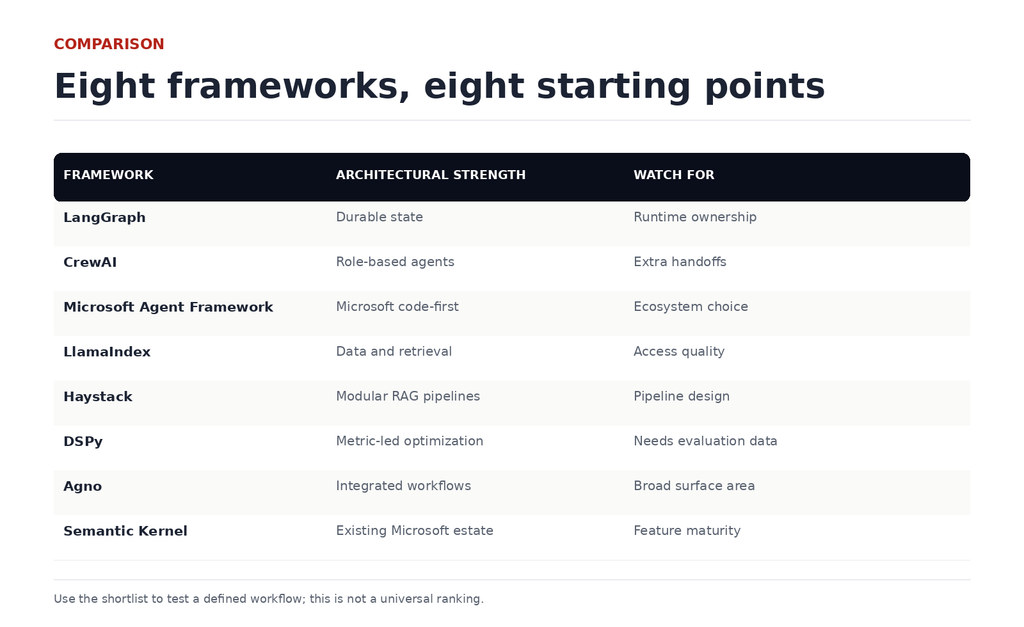
LangGraph: durable, stateful graph execution. CrewAI: agents with specialized roles in crews and flows. Microsoft Agent Framework: code-first agents and graph workflows in the Microsoft stack. LlamaIndex: data and retrieval-heavy agents.
Haystack: modular retrieval pipelines with agentic components. DSPy: optimization of language-model programs against defined metrics. Agno: integrated agents, teams, workflows, and runtime patterns. Semantic Kernel: existing Microsoft agent estates and orchestration patterns. These are architectural starting points, not a ranking.
Where each framework earns its place
LangGraph
LangGraph lets teams make state, branches, and interruptions explicit. A workflow can pause before a sensitive action, preserve its state, and resume after review. LangSmith adds tracing and evaluation. It suits long-running custom processes, provided the team can own the design and runtime.
CrewAI
CrewAI emphasizes role-based collaboration through agents, crews, and flows. Its production tooling covers deployment and monitoring. Use it when specialist agents really need to exchange work; every additional handoff creates another coordination and evaluation burden.
Microsoft Agent Framework
Microsoft Agent Framework is the current code-first direction for Microsoft-centric agent projects, with workflows, persistence, approvals, and observability in Python and .NET. Microsoft also provides migration guidance from AutoGen and Semantic Kernel. For a new project in that ecosystem, evaluate it before carrying forward an older pattern.
LlamaIndex
LlamaIndex puts enterprise knowledge and retrieval close to the agent workflow. It is a strong candidate when the hard part is finding and using the right data across multiple sources. Test retrieval quality and permissions on the actual knowledge base, not a sample corpus.
Haystack
Haystack composes reusable components into pipelines that can combine deterministic retrieval, branches, loops, tools, and agents. This helps when a production RAG process needs controlled steps around agent behavior. Its value is clearest when data retrieval and pipeline design are central.
DSPy
DSPy treats model behavior as a program that can be improved against a metric. It is useful for teams with representative examples and a way to score quality. It complements, rather than always replaces, the orchestration and operating layer of an agent system.
Agno
Agno brings agents, teams, and workflows into one Python environment. Its workflow patterns include routing, loops, parallel execution, and human review with persisted state. Evaluate whether this integrated surface matches the team’s deployment and maintenance preferences.
Semantic Kernel
Semantic Kernel remains relevant for applications already built on it. Microsoft documentation labels some agent orchestration features experimental, so new builds should compare its current capabilities and migration path with Agent Framework before committing to an architecture.
Run one production-shaped comparison
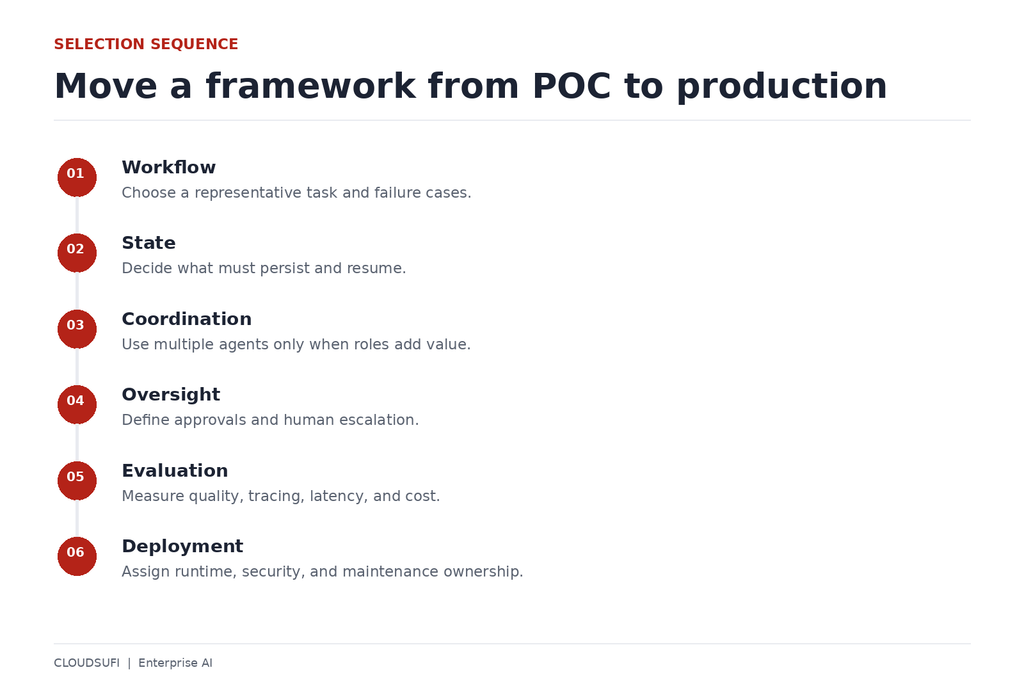
Use a workflow containing the difficult cases: a missing data source, a failed tool call, an ambiguous answer, and an action needing approval. For each framework, observe how execution pauses, retries, resumes, and exposes the decision trail.
Measure task completion, retrieval or tool success, quality on a fixed evaluation set, human escalation, latency, token and infrastructure cost, and engineering effort to deploy. A framework that wins a demo but requires disproportionate recovery code may not be the best production fit.
When to keep the architecture simpler
If the process is deterministic, use ordinary workflow automation. If retrieval followed by a response is enough, build a RAG application without adding autonomous steps. If an existing platform already handles the permissions and orchestration, first test whether custom framework code materially improves the result.
FAQ
What is the best agentic AI framework?
There is no universal winner. Start with the workflow’s need for state, retrieval, multiple agents, approval, and deployment control, then test the closest candidates.
Is LangGraph better than CrewAI?
LangGraph emphasizes explicit stateful execution; CrewAI emphasizes role-based agent collaboration. The architecture determines which is more useful.
What is the difference between a framework and a platform?
A framework supplies building blocks for custom logic. A platform usually provides more managed deployment, administration, and governance, although product boundaries overlap.
Should teams use AutoGen for a new Microsoft project?
Examine Microsoft Agent Framework first. Microsoft provides migration guidance from AutoGen and Semantic Kernel, while existing implementations may still warrant maintaining or migrating at their own pace.
From framework choice to a working system
A framework is only part of the production system. CLOUDSUFI works across enterprise data, integrations, orchestration, evaluation, and governance to make the agent’s actions reliable in the workflow that matters.