
A shortlist can hide four different purchases
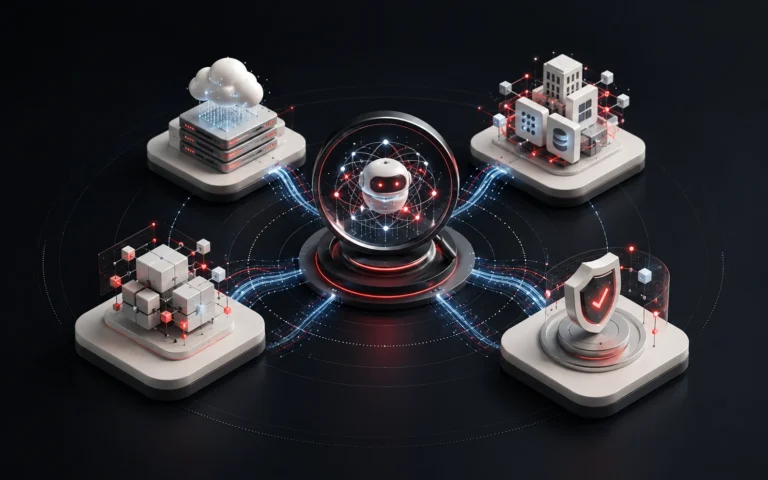
One vendor provides the model and developer tools. Another supplies a managed place to build and govern agents. A third orchestrates business processes across systems. An engineering partner connects the agent to company data and makes the operating model work. Calling all of them “agentic AI companies” makes the market look more interchangeable than it is.
The distinction becomes practical as soon as an agent can act. Someone must decide whose identity it uses, which tools it can call, when approval is required, and how a bad action is found and reversed. Begin with that responsibility, then choose the company type.
The four types of provider
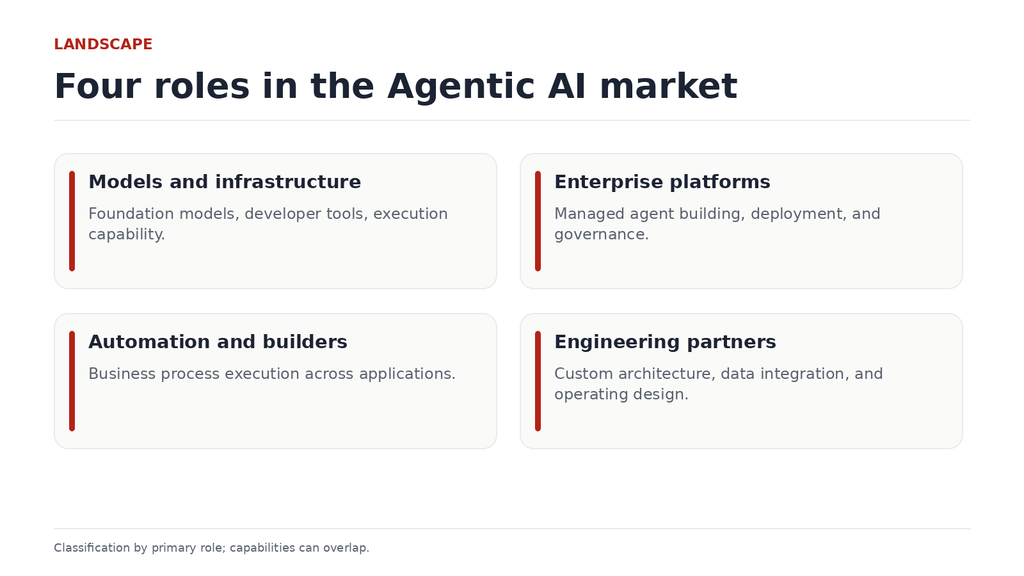
Model and agent infrastructure providers, such as OpenAI and Anthropic, supply models, tools, and developer capabilities for custom applications. Enterprise platforms, such as Microsoft, Salesforce, and Kore.ai, provide broader building and management environments.
Automation and AI-native workflow vendors, such as Automation Anywhere and Gumloop, focus on getting work done across processes and systems. Engineering and implementation partners, including Quantiphi and Kanerika in this comparison, design and integrate custom systems around existing data, applications, controls, and teams. Cognition represents a further specialist category focused on software engineering agents.
Ten companies and the problems they fit
Microsoft
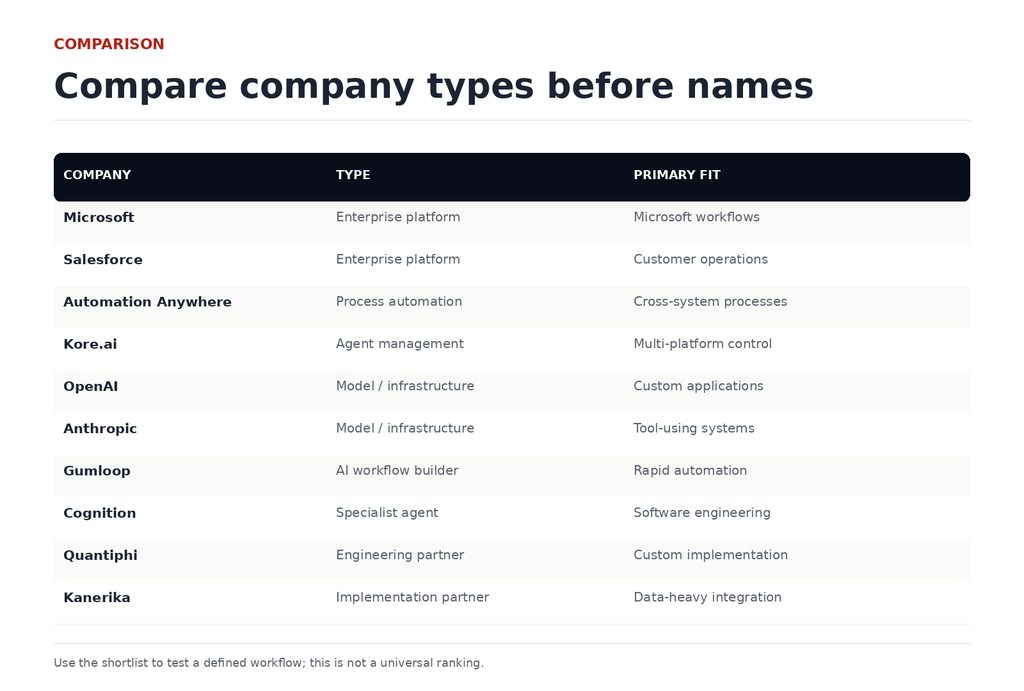
Microsoft is a natural starting point for organizations whose agents will operate through Microsoft 365, Azure, Power Platform, and related identity controls. Copilot Studio and Microsoft’s agent management capabilities put building and governance near existing employee workflows. Test the boundaries of a process that crosses into other ecosystems.
Salesforce
Salesforce fits sales, service, and other customer-facing processes whose records and rules live in its platform. Agentforce can draw on that context, with integrations for outside systems. Map the full customer workflow to see whether the main work occurs inside or beyond Salesforce.
Automation Anywhere
Automation Anywhere is suited to processes that mix AI decisions with bots, APIs, documents, and human work. That makes it relevant for long back-office workflows where end-to-end process execution matters more than a standalone conversational agent.
Kore.ai
Kore.ai is worth evaluating when a company needs to manage agents built in different places. Its agent management offering emphasizes central visibility, evaluation, and governance. Test it against the actual mix of agents, policies, and logs the enterprise needs to control.
OpenAI
OpenAI supplies models and agent developer tooling for highly custom applications. Engineering teams get room to design the tool and execution architecture. They must still address enterprise data access, identity, integration, evaluation, and ongoing operations around those building blocks.
Anthropic
Anthropic supplies Claude and tooling for reasoning-heavy agents that use enterprise context and tools. Its published work on containment underlines the security design problem: granting more tool access expands what an agent can affect. Evaluate the safeguards and approval boundaries of the complete application.
Gumloop
Gumloop offers a visual way to assemble AI-heavy workflows quickly. Speed can matter for internal automation, research, and document processes. For production, inspect access, data movement, audit logs, failure handling, and ownership with the same rigor used for larger platforms.
Cognition
Cognition’s Devin is a specialist agent for software engineering tasks. Evaluate it against defined coding workflows such as bug fixes or migrations. Its strength in that domain should not be treated as evidence that it solves general enterprise process automation.
Quantiphi
Quantiphi represents custom AI engineering and implementation at enterprise scale. An engineering partner becomes useful when the hard work is data integration, architecture, controls, and deployment across an existing estate. Ask for evidence on comparable production work and who operates the system after handoff.
Kanerika
Kanerika also represents the implementation category, particularly for data-heavy business workflows. Evaluate its engineering depth, integration approach, governance design, and operational handoff rather than treating a services provider like a packaged software product.
The buying decision behind the list
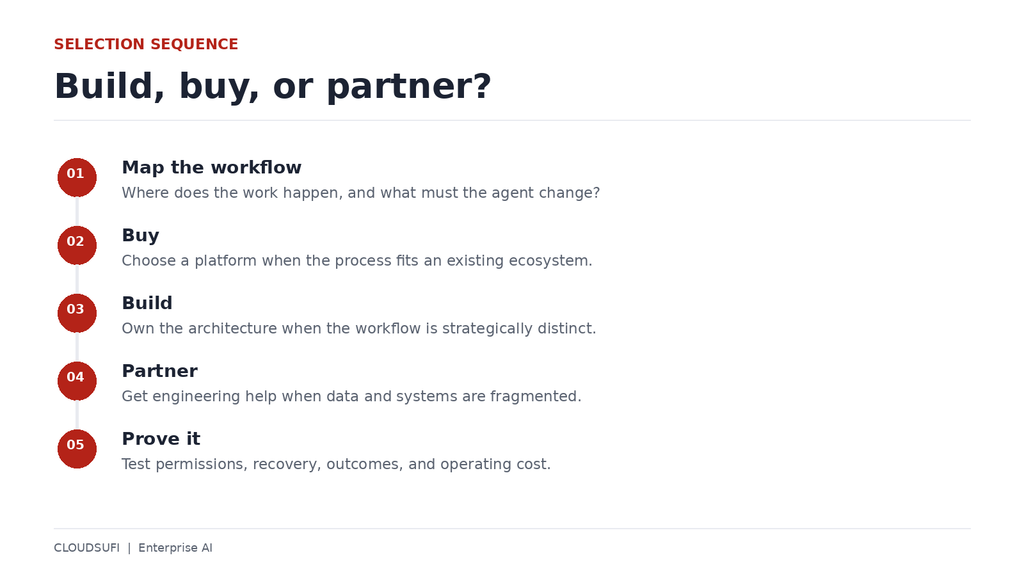
Build when the workflow is strategically distinct and the team can own custom engineering. Buy when the use case maps closely to an existing platform and its managed controls save time. Bring in a partner when fragmented data, legacy systems, cross-platform steps, or governance design make integration the primary challenge.
These routes can coexist. A company may buy the agent platform and still need a partner to redesign the workflow, set up permissions, build evaluations, and connect systems. Define the accountabilities separately in the selection process.
Test the company on one actual workflow
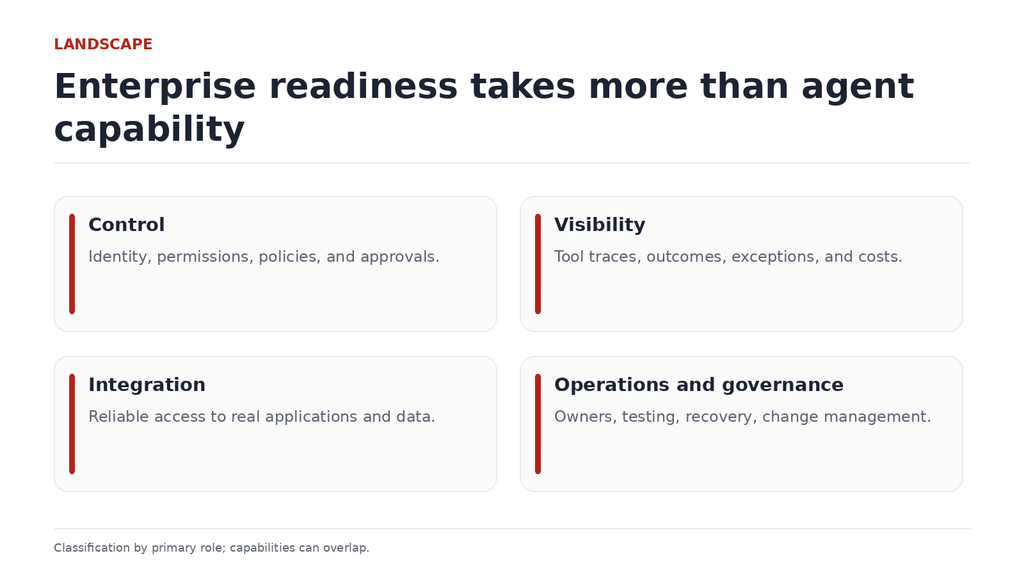
Give each finalist the same bounded process and success criteria. Ask it to show the agent’s identity, tool permissions, human approval point, tool-call trace, error recovery, and version testing. Record task completion, policy violations, escalation rate, latency, cost per completed task, integration effort, and ongoing operating work.
A polished demo is insufficient if the provider cannot explain what happens after a wrong action. The clearest warning signs are vague permission boundaries, no replayable trace, no evaluation method, and no named owner for the system after launch.
FAQ
What are the best agentic AI companies?
The answer depends on the layer required. Microsoft and Salesforce fit their application ecosystems; automation and specialist vendors fit narrower workflows; model providers support custom builds; engineering partners help integrate the complete system.
Is an agent platform the same as an agentic AI company?
A platform is one offering in the wider market. The term also covers model providers, automation vendors, specialist products, and implementation firms.
Should an enterprise build or buy?
A standard workflow inside an existing ecosystem may favor buying. A differentiated cross-system process may require custom engineering. Compare both against a real workflow and the team’s operating capacity.
When is an implementation partner useful?
When the difficult work lies in enterprise data, integration, orchestration, approvals, evaluation, and production operations rather than configuring an existing builder.
Make the architecture work beyond the demo
The vendor choice is one decision. The system also needs connected data, permissions, evaluation, monitoring, and a team responsible for change. CLOUDSUFI helps enterprises design and operate those parts together.