
An active product roadmap needed specialist engineering beyond standard integration recipes. CLOUDSUFI developed a tested bulk-data connector, employee support assistants, and a reusable permissions model through separate workstreams.

Workato was expanding into data integration, employee support, and access-aware search. Each area called for specialist knowledge beyond standard recipe development: bulk extraction from complex enterprise systems, grounded conversational support, and permission models that vary by application.
The work also had to fit an active product roadmap. Workato needed specialist skills when a gap appeared, without maintaining a dedicated team for every domain. CLOUDSUFI supplied connector and recipe engineering, technology assessment, and delivery support across the portfolio, with team capacity expanding or contracting with each workstream.
One delivery team worked across all three tracks, but each kept its own architecture, acceptance criteria, and evidence. Each workstream started with a product gap: CLOUDSUFI assessed it, built a prototype, then took the connector, assistant, or crawler through testing, tuning, and handoff — assess, prototype, engineer, deploy, support.
Existing SAP integrations supported transactional workflows and business-process automation, but they did not provide a scalable way to extract large datasets from on-premises and cloud SAP environments. This limited Workato’s ability to support analytics, migration, and enterprise data-pipeline use cases through the same integration experience.
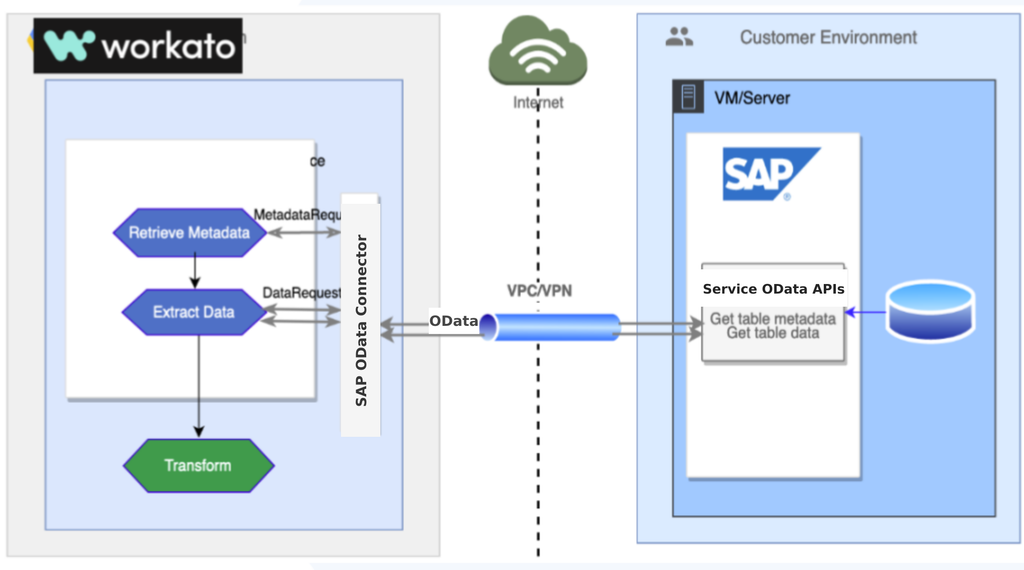
CLOUDSUFI built a custom SAP Data Agent that makes complex SAP data available through an OData integration layer. A single Workato interface routes requests across three extraction paths: Table Reader for tables and views, ODP for full and delta loads, and BW Open Hub for warehouse data. Metadata-driven schemas, filters, server-aware tuning, package retransfers, and snapshot controls help reduce the risk of failed transfers, lost data, and duplicates.
Testing showed the architecture could handle both scale and recovery. ODP runs processed up to approximately two million records, and BW Open Hub testing covered production, dynamic, and standard SAP environments. Workato now has a tested foundation for moving large SAP datasets through one integration experience.
The IT and HR assistants give employees one conversational entry point for common requests. The IT experience covers password, access, and device issues; the HR experience handles policy questions, employee information, and process guidance.
The assistants draw answers from approved knowledge, use connected systems for context, and hand complex requests to the right service team. Routine questions stay in self-service without trapping exceptions in an automated flow.
Access-control crawlers address a different problem: every enterprise application represents permissions through its own mix of users, groups, roles, direct grants, inherited access, policies, and external links.
The crawler design records securable objects, identities, grants, and the evidence behind inherited access. Full and incremental syncs publish normalized permissions records for access-aware search, reviews, audits, and exposure detection and remediation — discover, normalize, activate.
The designs cover ServiceNow and OneDrive/SharePoint, with Workday in the broader roadmap. Using the same subject–object–grant model across applications gives Workato a reusable starting point for access-aware search instead of rebuilding permission logic for each system.
CLOUDSUFI helped Workato turn three specialist product gaps into work the product team could build on. The employee assistants reduced IT tickets by 25% through deflection and achieved 95% successful results on the accuracy measure. Workato also gained a tested foundation for high-volume SAP extraction and a reusable permissions model for access-aware search.
The engagement also gave Workato a repeatable way to extend the platform without pulling core teams away from the roadmap. When a new gap appears, CLOUDSUFI can add the right specialist skills, test the idea quickly, and carry it through design, development, and handoff.
Let's build what's next.
Talk to us about your data and AI challenges — and how CLOUDSUFI can help solve them.
Talk to us →