
Enterprise applications expose changes through events, queues, polling, and service requests. CLOUDSUFI is developing a common runtime with source-specific extraction paths for initial loads, incremental changes, and recovery, so each path can support more than one client implementation.
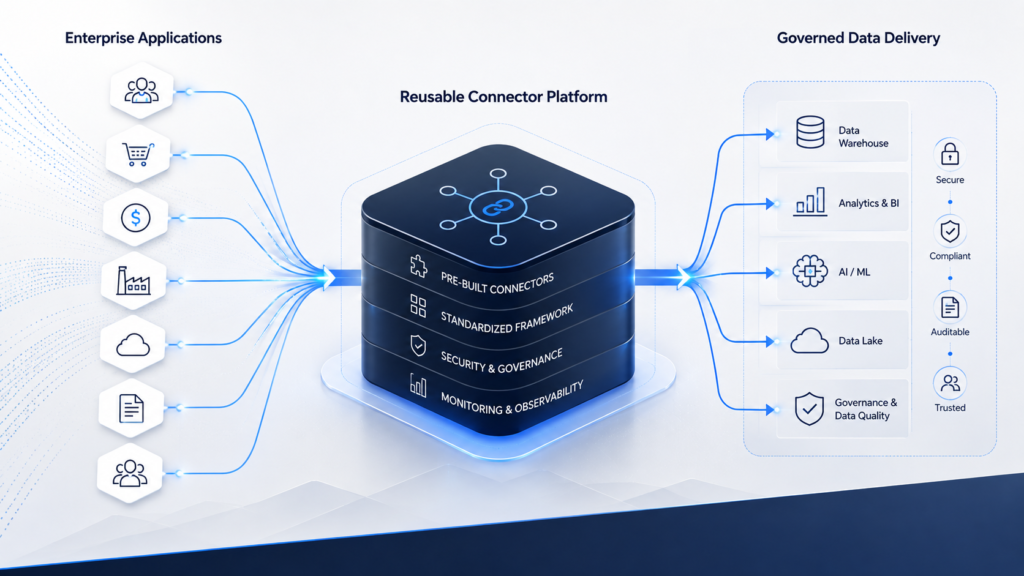
Enterprise data often sits across business applications that follow different rules for APIs, authentication, events, and change tracking. Replication patterns that work cleanly for databases do not transfer automatically to cloud applications.
CLOUDSUFI is working with Oracle on a reusable connector platform for four application categories. The aim is to engineer each source-specific extraction pipeline once. That pipeline can then be reused across different client implementations while the shared operating framework stays consistent.
Each source presents a different engineering problem. One may provide native events and replay. Another may expose structured queues. A third may require polling and watermarks. Those differences affect how a connector starts, resumes, retries, and preserves order. The program has to solve several related problems: move historical data first, then continue with incremental changes; support event streams, polling, and request-based extraction without forcing them into one artificial pattern; resume safely from checkpoints after an interruption; control retries, buffering, ordering, and delivery behavior; translate schemas and data types without losing source context; and give operations teams a consistent way to configure, observe, and support every connector.
The four workstreams follow the same engineering path. Requirements come first, followed by connector design and the shared runtime foundation. Source interfaces then implement the details of each application. End-to-end validation and release preparation bring the tracks back together. This sequence gives the program a common decision trail. It also makes source-specific risks visible early, before they surface in validation or support.
The platform separates reusable foundation capabilities from source-specific extraction engineering and client-specific connectivity. Each source still needs its own extraction pipeline because applications expose data, events, and changes differently. That source pipeline is engineered once so it can be reused across multiple client implementations instead of being rebuilt for every engagement.
The architecture has three layers. The shared foundation provides reusable machinery for typed configuration, polling and streaming profiles, initial loading, incremental capture, bounded or durable buffers, checkpoints, recovery, and delivery controls. Above it, the source-specific pipeline translates an application’s APIs, events, schemas, and change-tracking methods into the common contract. A thin client-specific connection layer then plugs that reusable source pipeline into the target environment without recreating the extraction logic.
Most of the engineering sits in the two reusable layers. Client-specific work is kept narrow, while improvements to shared runtime behavior can be applied centrally across connector implementations.
“Each application exposes change differently. The goal is to engineer the source-specific extraction pipeline once, then reuse it across client implementations while keeping delivery, recovery, and operational controls consistent.”
The shared adapter design uses explicit page boundaries and recorded source positions to make restart behavior predictable. Records are handed over in pages. A page position is written to durable storage only after the full page has been handed over. The page is released only after that position is safely recorded. If the position write fails, the page is returned for replay instead of being partially committed.
On restart, the connector resumes from its recorded source position. This produces an at-least-once delivery model. A complete page may be replayed after a failure, but the design avoids splitting a page between committed and uncommitted states. Target writes therefore need to be idempotent so replayed records can be absorbed safely.
Enterprise application data creates three practical pressures at once. Volume can exceed what a downstream system should consume in one burst. Variety comes from different schemas, APIs, and change mechanisms. Velocity changes by source and can arrive as events, queues, polling results, or request-based batches.
The connector model is designed to absorb those differences before delivery. Bounded or durable queues provide flow control. Source-specific interfaces normalize different extraction patterns into a common contract. The shared runtime then controls how records are delivered and resumed. The goal is not to make every source behave the same internally, but to give downstream operations a more consistent delivery model.
Based on the material available for review, the program covers four connector patterns. An event-driven source pairs bulk loading with native change events, replay, checkpoint repositioning, type mapping, and transaction handling. An enterprise application source combines structured extraction and incremental queues with type and transaction management. A table-based service uses polling and watermark-based change detection to support ordered capture, checkpoints, and replay. A service-contract source relies on stable service interfaces to support incremental extraction, with a request-based approach where the source requires it.
Without a reusable model, the same source extraction logic and operational controls can be recreated for different client implementations. The program instead engineers each source-specific pipeline once and combines it with a shared operating foundation. The reusable pipeline can then serve different clients through a thin client-specific connection layer. This reduces repeated engineering while keeping configuration, checkpoints, retries, recovery, and delivery behavior consistent.
“The objective is to make a source extraction pipeline reusable once it has been engineered, so new client implementations can connect that source without rebuilding the core extraction logic.”
This engagement is about data integration. It does not introduce an AI application. Its relevance to AI and advanced analytics lies in the data foundation it can provide. A governed connector platform can help downstream teams work with fresher operational data. It can also maintain continuity between initial loads and later changes, and make recovery traceable when a pipeline is interrupted. These capabilities support scalable ingestion for analytics, automation, and future AI environments.
The program establishes a practical route for engineering a source-specific extraction pipeline once and reusing it across client implementations. A common foundation supports runtime controls, recovery, and delivery. Measured performance and delivery outcomes will be added once they have been validated.
Let's build what's next.
Talk to us about your data and AI challenges — and how CLOUDSUFI can help solve them.
Talk to us →