
Publishing data from multiple agencies in a common format
Agencies and national ministries used different schemas and identifiers, making their datasets difficult to use together. CLOUDSUFI used custom Data Commons instances to map the data to a common model and built a repeatable process to validate and publish it. Teams could trace published data back to the original records.
- Harmonized varied source schemas and entity definitions within custom Data Commons instances.
- Built validation, record reconciliation, and lineage verification into the publication workflow.
- Created public and agency-facing data experiences supported by ingestion runbooks and troubleshooting playbooks.

Overview
The organization needed to bring together datasets produced by autonomous agencies and national ministries. These sources used different schemas, attribute definitions, and identifiers, making it difficult to organize information consistently across organizational and geographic boundaries.
The challenge extended beyond ingestion. Published datasets needed consistent entity definitions, verifiable record counts, and a traceable connection to their source material. Teams also needed a repeatable process for preparing, testing, loading, and maintaining data.
CLOUDSUFI engineered a standardized processing framework for custom Data Commons instances. The engagement combined source extraction, property-value mapping, entity resolution, validation, publication, and operational documentation to support a common approach across participating datasets.
Challenges
Bringing data together required consistency in structure, meaning, and provenance
Agency and ministry datasets reflected the systems and conventions of their respective producers. Loading these files into a shared platform would not, by itself, make the information interoperable.
The engagement addressed four connected challenges:
- Different source schemas: Incoming files used varied structures and attributes that needed to map to a common data model.
- Inconsistent entity definitions: Geographic, administrative, and socioeconomic entities needed to be matched across datasets.
- Limited lineage visibility: Teams needed to trace published information through its transformations back to the original source.
- Fragmented processing practices: Extraction, validation, loading, and troubleshooting needed a repeatable framework across data sources.
The platform had to preserve the meaning and provenance of incoming data while making it accessible through consistent structures.
Solution
A standardized path from source datasets to published data
CLOUDSUFI built the solution around custom Data Commons instances, supported by a cloud-native ingestion engine and the organization’s extraction, transformation, and loading framework.
A repeatable ingestion and publication workflow
The team established a 10-step processing workflow covering the full path from extraction to import registration:
- Execute source extraction through the organization’s ETL codebase.
- Create property-value mappings.
- Validate schema mappings.
- Resolve entities across source datasets.
- Generate deployment and indexing configuration files.
- Stage and test processed records.
- Load data into the target Data Commons instance.
- Reconcile record counts and verify lineage.
- Publish and index validated datasets.
- Register the ingestion event in the import tracking register.
This sequence embedded testing and reconciliation into the delivery process, providing defined checks before data became available through live queries and public search indexes.
Common definitions through property-value mapping
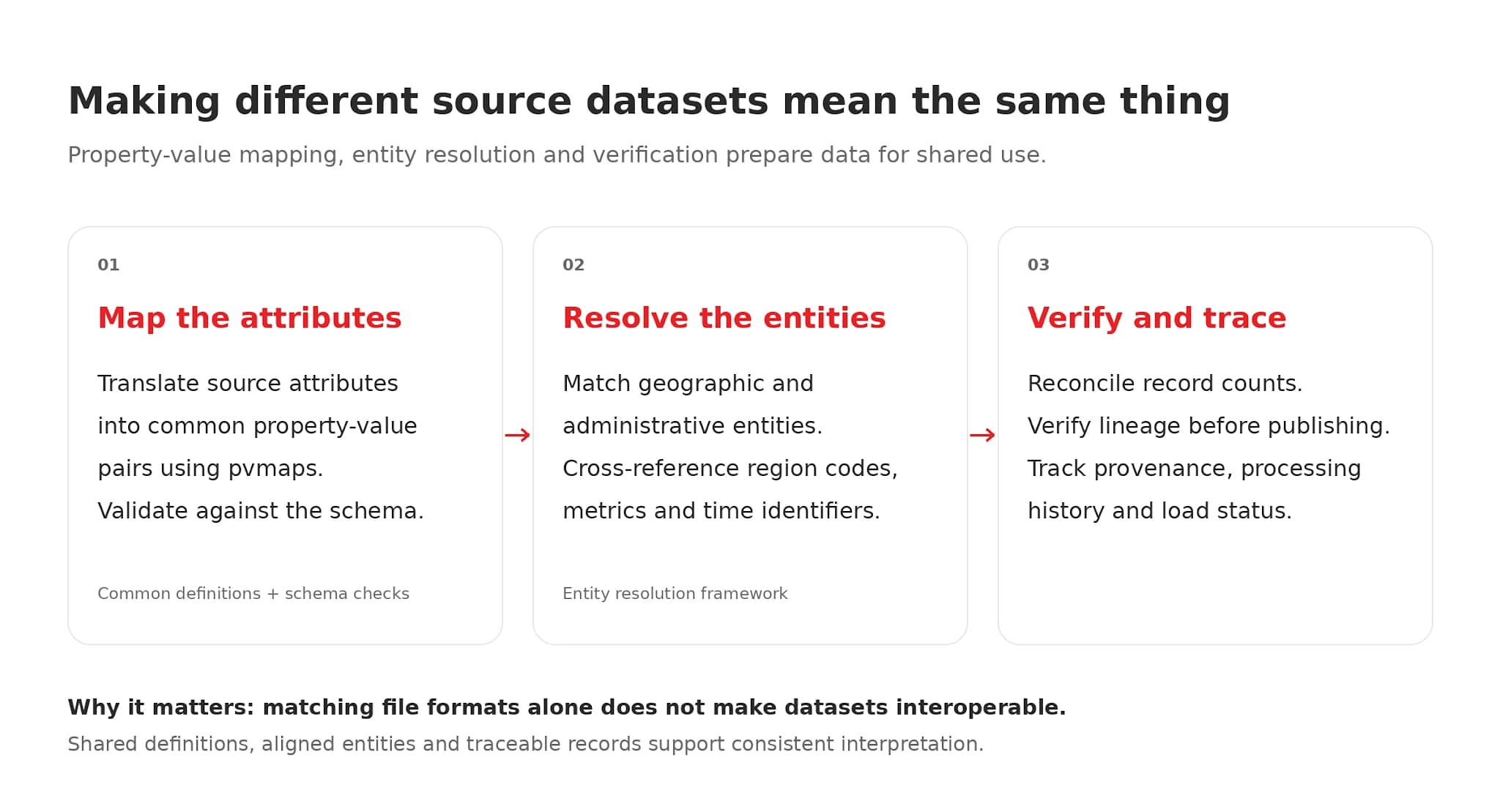
CLOUDSUFI implemented property-value mappings, known as pvmaps, to translate source attributes into a canonical schema.
The mappings separated source-specific structures from the target platform’s data model. This allowed datasets with different formats to be represented through standardized properties and values while retaining their underlying meaning.
Automated schema validation checked the mappings against central constraints before the data progressed through staging and publication.
Entity resolution across agency and ministry datasets
The entity resolution framework matched and linked geographic, administrative, and socioeconomic entities.
Automated cross-referencing covered region codes, statistical metrics, and time identifiers across datasets from 53 national ministries. These mappings supported consistent interpretation of entities across otherwise heterogeneous source files.
Traceability from published views to source uploads
The import tracking register recorded dataset provenance, transformation history, and load status.
Record-count reconciliation and lineage verification connected publication checks with the underlying ingestion history. This enabled teams to trace information from public-facing views back through processing stages to source uploads.
Data access supported by operational playbooks
CLOUDSUFI created customized Data Commons instances for policy researchers, international agencies, and government analysts.
The team also developed operational runbooks and troubleshooting guidance for recurring ingestion failures, missing schemas, and ambiguous entity matches. These playbooks documented how teams could investigate and resolve issues as datasets were processed and maintained.
Outcomes
A common framework made disparate datasets interoperable and traceable
The engagement enabled data interchange across five agencies and supported standardized mapping and entity resolution across datasets from 53 national ministries.
The 10-step workflow established a repeatable approach to preparing, validating, loading, and publishing data. Schema checks, staging tests, record reconciliation, and lineage verification became defined parts of that process.
Custom Data Commons instances made the harmonized information accessible to researchers, agencies, and government analysts. The import tracking register preserved the connection between published information, transformation history, and source records.
Together, these capabilities gave participating teams a shared foundation for multi-agency data delivery: consistent definitions, repeatable processing, traceable publication, and documented operational support.
Let’s build what’s next.
Talk to us about unifying fragmented datasets and building trusted, accessible data platforms.
Book Workshop →